
By staff | Last Updated: June 2026
8-minute read
Want to Invest in AI? Here’s How Americans Can Get Started in 2026
Artificial intelligence is everywhere these days.
It’s helping doctors diagnose diseases, powering self-driving vehicles, improving online shopping experiences, and even creating content. What once sounded like science fiction has become a major force in the American economy.
Naturally, many investors are wondering how they can profit from this technological revolution.
If you’ve been hearing about AI stocks and wondering whether they’re worth investing in, you’re not alone. The good news is that you don’t need to be a technology expert or Wall Street professional to get started.
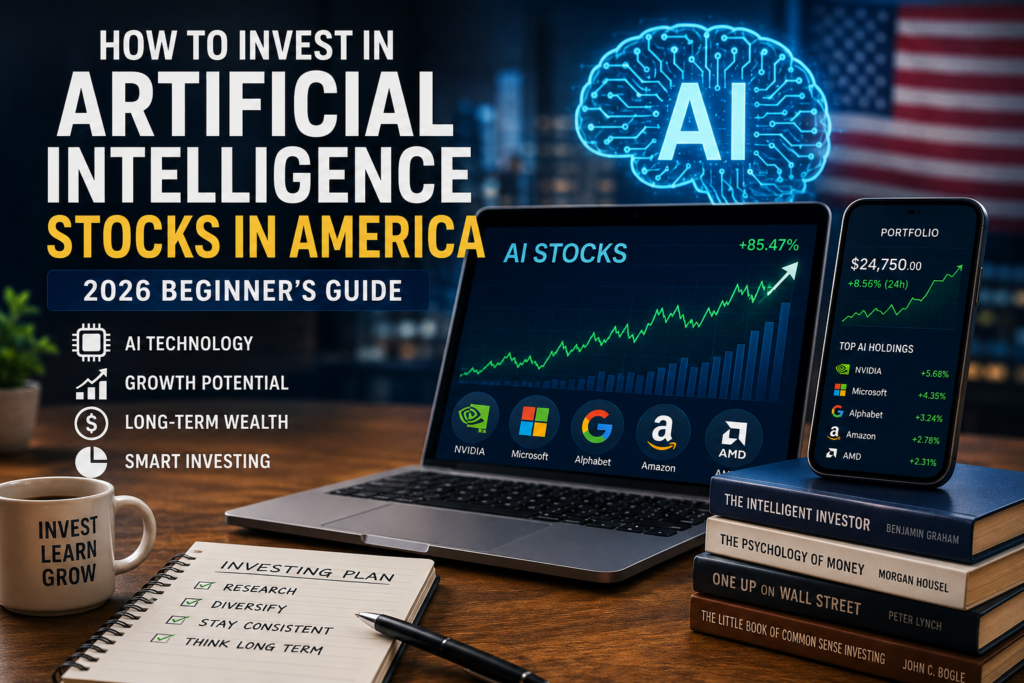
This beginner-friendly guide will show you how to invest in artificial intelligence stocks, which companies are leading the AI race, the risks you should know about, and some of the best investing books that can help you become a smarter investor.
Let’s dive in.
Why AI Stocks Are Getting So Much Attention
Every few decades, a technology comes along that changes everything.
The internet did it.
Smartphones did it.
And now, many experts believe artificial intelligence could be the next major economic transformation.
Businesses across America are investing billions of dollars into AI because it can save time, reduce costs, improve productivity, and create entirely new products and services.
From banks and hospitals to retailers and manufacturers, companies are finding ways to use AI to stay competitive.
For investors, that creates an exciting opportunity.
The companies building the hardware, software, and infrastructure behind AI could continue growing for years to come.
What Exactly Are AI Stocks?
Simply put, AI stocks are shares of companies that develop, support, or heavily use artificial intelligence technology.
Not all AI companies look the same, though.
Some build the powerful computer chips needed to train AI systems. Others develop AI software. Some provide the cloud computing services that allow AI applications to run at scale.
Understanding these categories can help you make better investment decisions.
AI Hardware Companies
Think of these companies as the builders of AI’s foundation.
Artificial intelligence requires enormous computing power, and specialized computer chips make that possible.
Some of the biggest names include:
- NVIDIA
- AMD
- Intel
Without their technology, many modern AI systems simply couldn’t function.
AI Software Companies
These businesses create the tools and applications that people use every day.
Examples include:
- Microsoft
- Alphabet (Google)
- Palantir Technologies
They’re developing AI assistants, machine-learning platforms, and business solutions that are changing how work gets done.
Cloud Computing Providers
AI models require vast amounts of storage and processing power.
That’s where cloud computing comes in.
Companies such as:
- Amazon
- Microsoft
provide the infrastructure that allows AI applications to operate efficiently across the globe.
Why So Many Americans Are Investing in AI
AI isn’t just another investment trend.
Many investors see it as a long-term growth story that could unfold over the next decade or
even longer.
Here are a few reasons AI investing has become so popular.
Massive Growth Potential
We’re still in the early stages of AI adoption.
Businesses are only beginning to discover what artificial intelligence can do.
As usage expands, many AI-related companies could see substantial increases in revenue and profits.
AI Is Impacting Nearly Every Industry
One of the most exciting things about artificial intelligence is its versatility.
Unlike some technologies that affect only a single sector, AI has applications across countless industries, including:
- Healthcare
- Finance
- Education
- Transportation
- Manufacturing
- Cybersecurity
- Retail
This broad reach creates multiple opportunities for investors.
Long-Term Wealth Building
Many successful investors focus on long-term trends rather than short-term market noise.
AI appears to be one of those trends.
Rather than trying to predict what will happen next month, many investors are positioning themselves for growth over the next 10 to 20 years.
Best AI Stocks for Beginners in 2026
No stock is guaranteed to make money, and every investment carries risk.
That said, several companies have established themselves as major players in the AI industry.
NVIDIA (NASDAQ: NVDA)
If AI had a poster child, NVIDIA would probably be it.
The company designs the graphics processing units (GPUs) that power many of today’s most advanced AI systems.
Its technology is used by data centers, researchers, and technology companies worldwide.
Why investors like NVIDIA:
- Industry-leading AI chips
- Strong revenue growth
- Dominant market position
Microsoft (NASDAQ: MSFT)
Microsoft has quietly become one of the most influential AI companies on the planet.
Through its cloud platform, Azure, and extensive AI investments, the company has positioned itself at the center of the AI revolution.
Investors appreciate Microsoft’s:
- Diverse revenue streams
- Strong financial stability
- Growing AI ecosystem
Alphabet (NASDAQ: GOOGL)
Google’s parent company has been investing in artificial intelligence for years.
Today, AI powers everything from search results and advertising to cloud services and autonomous driving projects.
Alphabet remains one of the most important companies in the AI landscape.
Amazon (NASDAQ: AMZN)
Many people think of Amazon as an online retailer, but it’s much more than that.
Its cloud division, AWS, plays a critical role in supporting AI applications around the world.
The company also uses AI extensively in logistics, inventory management, and customer service.
AMD (NASDAQ: AMD)
AMD has become a serious competitor in the AI hardware market.
As demand for AI chips continues growing, AMD could benefit from increased adoption of its technology.
Should You Buy Individual AI Stocks or AI ETFs?
This is one of the first questions many beginner investors ask.
The answer depends on your goals and risk tolerance.
Buying Individual AI Stocks
Investing directly in companies gives you more control and potentially greater rewards.
Pros:
- Higher growth potential
- Direct ownership of companies you believe in
- Greater flexibility
Cons:
- More risk
- More research required
- Larger price swings
Investing in AI ETFs
An AI ETF (Exchange-Traded Fund) owns shares in multiple AI-related companies.
Instead of betting on one company, you’re investing in an entire group.
Pros:
- Instant diversification
- Lower company-specific risk
- Beginner-friendly
Cons:
- Slightly lower upside potential
- Management fees
For many new investors, ETFs offer a simpler and less stressful way to gain exposure to the AI industry.
How to Start Investing in AI Stocks
Getting started is easier than many people think.
Step 1: Open a Brokerage Account
Choose a reputable U.S. brokerage platform.
Popular options include:
- Fidelity
- Charles Schwab
- Vanguard
- E*TRADE
- Robinhood
Compare fees, investment tools, and educational resources before making a decision.
Step 2: Set Clear Goals
Before investing a dollar, ask yourself:
- Am I investing for retirement?
- Am I building long-term wealth?
- How much risk can I comfortably handle?
Your answers will help guide your strategy.
Step 3: Do Your Homework
Don’t buy a stock simply because it’s trending on social media.
Take time to understand:
- How the company makes money
- Revenue growth trends
- Profitability
- Competitive advantages
- Future opportunities
A little research can go a long way.
Step 4: Diversify Your Portfolio
Even the best companies can have difficult years.
That’s why diversification matters.
Instead of putting all your money into one stock, consider spreading investments across multiple companies and sectors.
Step 5: Stay Consistent
One of the simplest wealth-building strategies is dollar-cost averaging.
This means investing a fixed amount on a regular schedule regardless of market conditions.
Over time, consistency often matters more than trying to perfectly time the market.
Common Mistakes New AI Investors Make
Let’s talk about a few pitfalls that catch many beginners.
Getting Caught Up in the Hype
Not every company that uses the term “AI” is a great investment.
Some businesses benefit from the buzz without having meaningful AI products or revenue.
Focus on fundamentals, not headlines.
Ignoring Valuation
A great company can still be a poor investment if investors pay too much for the stock.
Always consider valuation alongside growth potential.
Investing Emotionally
Fear and greed are powerful forces.
The most successful investors usually stick to a plan rather than reacting to every market movement.
Putting All Your Eggs in One Basket
Concentrating your entire portfolio in a single AI stock increases risk dramatically.
Diversification remains one of the best tools investors have.
Understanding the Risks
AI investing can be exciting, but it’s important to keep expectations realistic.
Some risks include:
Market Volatility
Technology stocks often experience larger price swings than the broader market.
Intense Competition
The AI industry evolves rapidly.
Today’s leader may not necessarily remain on top forever.
Regulatory Changes
Governments are increasingly discussing AI regulation, which could affect how companies operate.
Technological Disruption
Innovation moves quickly, and companies must constantly adapt to stay competitive.
Smart investors recognize both the opportunities and the risks.
Best Books for Learning About Investing
Before investing heavily in AI stocks, consider investing in your financial education first.
These books have helped millions of investors build wealth.
1. The Intelligent Investor by Benjamin Graham
Why readers love it:
- Considered the bible of value investing
- Teaches risk management
- Recommended by Warren Buffett
Best for: Beginners and long-term investors
2. The Psychology of Money by Morgan Housel
What readers learn:
- Wealth-building habits
- Financial decision-making
- Behavioral finance principles
Best for: Anyone interested in building wealth
3. One Up On Wall Street by Peter Lynch
Key topics:
- Finding growth stocks
- Stock research
- Long-term investing
Best for: New stock investors
4. Common Stocks and Uncommon Profits by Philip Fisher
Why it’s valuable:
- Understanding innovative companies
- Evaluating management quality
- Growth investing strategies
Best for: AI and technology investors
5. The Little Book of Common Sense Investing by John C. Bogle
Readers learn:
- Index fund investing
- Portfolio building
- Long-term wealth creation
Best for: Passive investors
6. A Random Walk Down Wall Street by Burton G. Malkiel
Topics covered:
- Market history
- Portfolio diversification
- Investment strategies
Best for: Serious investors
7. The Simple Path to Wealth by J. L. Collins
Why it converts well for affiliates:
- Easy to read
- Strong reviews
- Popular among younger investors
Best for: Building long-term wealth
8. Rich Dad Poor Dad by Robert Kiyosaki
Popular topics:
- Financial education
- Asset building
- Wealth mindset
Best for: Beginners interested in personal finance
The Future of AI Investing Looks Bright
Nobody can predict the future with certainty.
However, artificial intelligence is already changing how businesses operate and how consumers interact with technology.
Many of America’s largest corporations are investing heavily in AI infrastructure, software development, automation, and machine learning.
That suggests the AI story is far from over.
For investors willing to think long term, continue learning, and remain patient during market ups and downs, artificial intelligence may offer some of the most compelling opportunities of the next decade.
Final Thoughts
Artificial intelligence is shaping up to be one of the defining investment themes of our generation.
Whether you choose individual AI stocks like NVIDIA, Microsoft, Alphabet, Amazon, and AMD, or prefer the diversification offered by AI-focused ETFs, the most important step is getting started with a clear plan.
Learn continuously. Invest consistently. Stay diversified.
And remember, the investors who build lasting wealth are rarely the ones chasing quick profits. They’re the ones who remain patient, informed, and focused on the long term.
The AI revolution is still in its early chapters. For prepared investors, the next decade could be full of opportunity.
Frequently Asked Questions (FAQs)
1. What are artificial intelligence (AI) stocks?
AI stocks are shares of companies that develop, support, or use artificial intelligence technologies. These may include AI chip manufacturers, cloud computing providers, software developers, robotics companies, and businesses integrating AI into their products and services.
2. Is investing in AI stocks a good idea in 2026?
Many investors believe AI remains one of the strongest long-term growth trends. However, like all investments, AI stocks carry risks. Investors should research companies carefully and maintain a diversified portfolio.
3. What are the best AI stocks for beginners?
Popular AI stocks often mentioned by investors include:
- NVIDIA
- Microsoft
- Alphabet
- Amazon
- Advanced Micro Devices
4. How much money do I need to start investing in AI stocks?
Many brokerages allow investors to start with as little as $10 to $100 using fractional shares. The most important factor is consistency rather than the amount you begin with.
5. Are AI stocks risky?
Yes. AI stocks can be volatile due to changing technology, competition, market sentiment, and government regulations. Investors should only invest money they can afford to keep invested long term.
6. Should I buy individual AI stocks or AI ETFs?
Beginners often prefer AI ETFs because they provide diversification across multiple companies. Individual stocks may offer higher growth potential but usually come with greater risk.
7. What is the best AI ETF for beginners?
Popular AI-focused ETFs include:
- Global X Robotics & Artificial Intelligence ETF (BOTZ)
- iShares Future AI & Tech ETF (ARTY)
- ROBO Global Robotics and Automation Index ETF (ROBO)
Investors should review each ETF’s holdings and fees before investing.
8. Can AI stocks make you rich?
Some AI companies have generated exceptional returns for investors. However, no stock guarantees profits. Successful investing typically requires patience, diversification, and a long-term mindset.
9. How do I research an AI company before investing?
Look at:
- Revenue growth
- Earnings and profitability
- Competitive advantages
- Management team
- Market share
- Future growth opportunities
Reading annual reports and earnings reports can provide valuable insights.
10. Are AI stocks good for retirement investing?
Many investors include AI stocks as part of a diversified retirement portfolio because they believe AI will continue growing over the next several decades.
11. What are the biggest risks facing AI companies?
Common risks include:
- Increased competition
- Economic slowdowns
- Government regulation
- Technological disruption
- High stock valuations
12. How long should I hold AI stocks?
Most successful investors view AI as a long-term investment theme. Many hold quality AI stocks for five, ten, or even twenty years.
13. Can I invest in AI through my IRA or 401(k)?
Yes. Many brokerage IRAs and employer-sponsored retirement plans offer access to AI stocks, technology funds, or AI-focused ETFs.
14. What industries benefit most from artificial intelligence?
AI is transforming:
- Healthcare
- Finance
- Manufacturing
- Transportation
- Cybersecurity
- Education
- Retail
- Energy
15. What is the safest way to invest in AI?
For many beginners, a diversified AI ETF combined with broad-market index funds offers a balanced approach to participating in AI growth while reducing company-specific risk.
Disclosure: This article is for informational and educational purposes only and should not be construed as personalized financial advice. Always consult a licensed financial advisor before making investment decisions. This article contains affiliate links.We only recommend books we genuinely believe in.