
By staff | Last Updated: July 2026
12-minute read
Let’s be honest — when most people hear the word “investing,” they immediately think of stock market crashes, confusing financial jargon, or risky bets that only wealthy people understand. But growing your money safely doesn’t have to be stressful or complicated.
In reality, many financially successful Americans didn’t become wealthy overnight. They built their money slowly through smart habits, consistent investing, and patience. They avoided chasing “get rich quick” schemes and focused on long-term financial security instead.
If you’re trying to save for retirement, build passive income, beat inflation, or simply stop living paycheck to paycheck, learning how to grow your money safely is one of the best financial decisions you can make in 2026.
The good news? You don’t need to be a Wall Street expert to get started.
In this beginner-friendly guide, you’ll learn practical and low-risk ways Americans are building wealth today — plus several personal finance books that can help you grow financially.
Why Growing Your Money Safely Matters
A lot of Americans work hard for their money but unknowingly let it lose value over time.
How?
Because inflation quietly eats away at savings sitting in low-interest bank accounts. If inflation is rising at 3%–4% per year while your savings account earns less than 1%, your money is actually shrinking in purchasing power.
That’s why growing your money matters.
Safe wealth-building isn’t about gambling or becoming rich overnight. It’s about making smart financial decisions that help your money grow steadily while protecting your future.
When you grow your money safely, you can:
- Build long-term financial security
- Prepare for retirement
- Handle emergencies with less stress
- Create passive income
- Protect yourself from inflation
- Gain more freedom and peace of mind
Legendary investor Warren Buffett once said:
“The stock market is a device for transferring money from the impatient to the patient.”
That quote perfectly explains how real wealth is built — slowly and consistently.
1. Start With an Emergency Fund
Before you start investing, the smartest thing you can do is build an emergency fund.
Life happens. Cars break down. Medical bills show up unexpectedly. Jobs become unstable. Without savings, even small emergencies can push people into debt.
An emergency fund gives you breathing room.
Most financial experts recommend saving:
- 3–6 months of living expenses
- In a separate high-yield savings account
- Where it’s easy to access when needed
This money isn’t meant to make huge returns. Its job is to protect you financially during difficult moments.
One of the best beginner books for learning this strategy is The Total Money Makeover by Dave Ramsey. Basically, the book walks readers through budgeting, saving, and getting out of debt in a practical, step-by-step way.
2. Use High-Yield Savings Accounts
Traditional bank accounts often pay extremely low interest rates. That means your money mostly sits there doing very little.
High-yield savings accounts are different.
They typically offer better interest rates while still keeping your money safe and accessible.
Why many Americans prefer them:
- FDIC-insured protection
- Higher interest earnings
- Low risk
- Easy online banking access
These accounts are ideal for:
- Emergency funds
- Vacation savings
- Down payment savings
- Short-term financial goals
Will they make you rich? No.
But they’re one of the safest places to grow money without exposing yourself to major risk.
3. Invest in Index Funds
If you ask many financial experts for the safest long-term investing strategy, there’s a good chance they’ll mention index funds.
An index fund allows you to invest in hundreds of companies at once instead of relying on a single stock.
For example, many index funds track the S&P 500, which includes some of America’s largest companies.
That means your investment is automatically diversified.
Why people love index funds:
- Lower risk than individual stocks
- Lower investment fees
- Historically solid long-term returns
- Beginner-friendly investing
Instead of trying to “beat the market,” index fund investors focus on growing wealth steadily over time.
One highly recommended book on this topic is The Simple Path to Wealth by JL Collins. It explains investing in a simple, easy-to-understand way that beginners appreciate.
4. Take Advantage of Retirement Accounts
One of the biggest financial advantages Americans have is access to retirement investment accounts with tax benefits.
The two most popular options are the 401(k) and Roth IRA.
401(k)
A 401(k) is usually offered through employers.
Benefits include:
- Tax advantages
- Automatic investing from your paycheck
- Employer matching contributions
- Long-term compound growth
If your employer matches contributions, that’s essentially free money added to your retirement savings.
Roth IRA
A Roth IRA allows your investments to grow tax-free over time.
Benefits include:
- Tax-free withdrawals in retirement
- Flexible investment options
- Excellent for younger investors
Many financially successful Americans use both accounts together.
A great book that teaches modern money management strategies is I Will Teach You to Be Rich by Ramit Sethi. Despite the bold title, the advice is realistic, practical, and beginner-friendly.
5. Stay Away From “Get Rich Quick” Schemes
One of the fastest ways to lose money is chasing easy money.
Unfortunately, social media is full of people promising overnight success through:
- Day trading
- Crypto hype
- MLM businesses
- Penny stocks
- “Secret investment systems”
If something sounds too good to be true, it usually is.
Safe investing is often boring — and that’s completely okay.
Real wealth usually comes from:
- Patience
- Consistency
- Smart investing habits
- Long-term thinking
One of the best books about this mindset is The Psychology of Money by Morgan Housel. It explains how emotions and behavior often matter more than intelligence when it comes to money.
6. Diversify Your Investments
There’s a popular saying in investing:
“Don’t put all your eggs in one basket.”
That’s exactly what diversification means.
Instead of putting all your money into one investment, many Americans spread their money across different assets like:
- Index funds
- Bonds
- Retirement accounts
- Real estate
- Savings accounts
- Dividend stocks
Diversification helps reduce risk because if one investment performs poorly, the others may still perform well.
Even experienced investors like Warren Buffett prioritize protecting their money before chasing higher returns.
7. Invest Consistently Over Time
A lot of beginners wait for the “perfect” time to invest.
The problem is that nobody can predict the market perfectly.
That’s why many investors use a strategy called dollar-cost averaging.
This simply means investing a fixed amount regularly, no matter what the market is doing.
Examples:
- $100 every week
- $300 every month
- Automatic investments into index funds
This strategy helps remove emotion from investing and encourages long-term consistency.
And honestly, consistency usually matters more than timing.
8. Understand the Power of Compound Interest
Compound interest is where your money starts earning money on itself.
Over time, this creates powerful long-term growth.
Even small monthly investments can grow dramatically over decades if you stay consistent.
For example, someone investing regularly in their 20s often ends up with significantly more wealth than someone who waits until their 40s — even if the later investor contributes more money overall.
One influential beginner finance book covering this concept is Rich Dad Poor Dad by Robert Kiyosaki. While some ideas are debated, the book has inspired millions to think differently about money and investing.
9. Keep Investment Fees Low
Many people ignore investment fees because they seem small at first.
But over time, fees can quietly cost you thousands of dollars.
Common fees include:
- Financial advisor fees
- Mutual fund fees
- Trading commissions
- Management expenses
Low-cost index funds remain popular partly because they keep fees minimal.
And in long-term investing, keeping more of your money matters.
10. Never Stop Learning About Money
Financial education is one of the best investments you can make.
The more you learn about:
- Budgeting
- Investing
- Taxes
- Retirement planning
- Debt management
…the more confident and financially secure you become.
Some excellent personal finance books Americans still love in 2026 include:
These books are also excellent affiliate recommendations because they remain relevant year after year.
Common Mistakes People Make When Trying to Build Wealth
Even smart people make money mistakes sometimes.
Some of the most common include:
1.Spending More Than They Earn
Lifestyle inflation can destroy savings potential.
2.Waiting Too Long to Invest
Time is one of the biggest advantages in investing.
3.Panic Selling During Market Drops
Markets naturally rise and fall over time.
4.Ignoring Retirement Accounts
Many people miss valuable tax benefits.
5.Carrying High-Interest Debt
Credit card debt can quickly cancel out investment gains.
Building wealth safely is usually simple: Spend less than you earn, invest consistently, and stay
patient.
Can You Still Grow Money During a Recession?
Absolutely.
In fact, many experienced investors continue investing during recessions because prices are often lower.
While recessions can feel scary, they also create opportunities for long-term investors.
During uncertain times, focus on:
- Keeping emergency savings
- Staying diversified
- Avoiding emotional decisions
- Continuing long-term investing
Historically, the American stock market has recovered from every major downturn over time.
Final Thoughts
Growing your money safely isn’t about luck, secret tricks, or becoming an overnight millionaire.
It’s about making smart decisions consistently over time.
For most Americans, the safest path to long-term wealth includes:
- Emergency savings
- Index fund investing
- Retirement accounts
- Diversification
- Patience
- Ongoing financial education
The earlier you start, the better.
Even small investments made consistently can create meaningful wealth over the long run.
You don’t need to know everything to begin. You just need a simple plan and the willingness to stay consistent.
?? Frequently Asked Questions
1. What is the safest way to grow money in 2026?
The safest ways to grow money in 2026 include high-yield savings accounts, certificates of deposit (CDs), Treasury bonds, index funds, and retirement accounts like 401(k)s and IRAs. These options help Americans build wealth steadily while reducing unnecessary risk.
2. Can I grow my money without taking big risks?
Yes. You don’t need risky investments to build wealth. Many successful investors focus on long-term investing, diversification, and consistent contributions instead of chasing quick profits.
3. How much money do I need to start investing safely?
You can start with as little as $10 to $100. Many investment apps and brokerages now allow fractional investing, making it easier for beginners to invest safely with small amounts.
4. Are high-yield savings accounts worth it in 2026?
High-yield savings accounts are still one of the safest places to store emergency funds while earning better interest than traditional savings accounts. They are ideal for short-term savings goals and financial security.
5. What are the best low-risk investments for beginners?
Some beginner-friendly low-risk investments include:
- Index funds
- ETFs
- Treasury bonds
- Money market accounts
- CDs
- Dividend-paying stocks
These options are popular because they balance growth and stability.
6. Is investing in index funds safe?
Index funds are considered one of the safest long-term investment strategies because they spread your money across many companies instead of relying on a single stock. This helps reduce investment risk over time.
7. How can Americans beat inflation safely?
To beat inflation safely, many Americans combine:
- High-yield savings
- Diversified stock market investments
- Real estate investments
- Retirement accounts
- Treasury Inflation-Protected Securities (TIPS)
This helps money grow faster than rising living costs.
8. What is the difference between saving and investing?
Saving focuses on protecting your money for short-term goals, while investing focuses on growing your wealth over the long term. Most financial experts recommend doing both.
9. Are CDs a good investment in 2026?
Certificates of Deposit (CDs) can be a good low-risk investment if you want guaranteed returns and don’t need immediate access to your money before the maturity date.
10. How long does it take to grow wealth safely?
Growing wealth safely usually takes years, not weeks. Consistent investing, compound interest, and patience are key factors in building long-term financial security.
11. What is compound interest and why is it important?
Compound interest allows you to earn returns not only on your original money but also on the interest or profits you’ve already earned. Over time, compound growth can significantly increase your wealth.
12. Should beginners invest during a market downturn?
Many experts believe market downturns can create long-term buying opportunities. Beginners who invest consistently over time often benefit from dollar-cost averaging instead of trying to time the market.
13. What is dollar-cost averaging?
Dollar-cost averaging means investing a fixed amount regularly, regardless of market conditions. This strategy helps reduce emotional investing and lowers the risk of buying at the wrong time.
14. Is real estate still a safe investment in America?
Real estate can still be a relatively safe long-term investment if you choose the right location, manage debt carefully, and focus on cash flow instead of speculation.
15. What are the biggest mistakes people make when trying to grow money?
Common mistakes include:
- Chasing “get rich quick” schemes
- Investing emotionally
- Ignoring diversification
- Not having an emergency fund
- Waiting too long to start investing
16. Should I pay off debt before investing?
It depends on the interest rate. High-interest debt like credit cards should usually be paid off first. However, many Americans still invest while paying down manageable low-interest debt.
17. Are retirement accounts good for safe wealth growth?
Yes. Retirement accounts like 401(k)s and Roth IRAs offer tax advantages and long-term growth opportunities that help Americans build wealth more efficiently.
18. What are Treasury bonds and are they safe?
Treasury bonds are government-backed investments issued by the U.S. Treasury. They are considered among the safest investments because they are backed by the federal government.
19. Can passive income help grow wealth safely?
Yes. Passive income sources such as dividend stocks, rental properties, and bond interest can help create steady cash flow while building long-term financial stability.
20. What is the best financial habit for building wealth?
Consistency is one of the most powerful wealth-building habits. Regular saving, disciplined investing, avoiding unnecessary debt, and staying patient are key to long-term financial success.
21. Is it too late to start investing in your 30s, 40s, or 50s?
No. While starting early helps, many Americans successfully build wealth later in life by increasing contributions, investing consistently, and focusing on long-term financial planning.
22. How can beginners avoid investment scams?
To avoid scams:
- Research investments carefully
- Avoid guaranteed-return promises
- Use regulated financial institutions
- Verify advisors and platforms
- Stay cautious of social media hype
23. What role does diversification play in safe investing?
Diversification spreads your money across different assets like stocks, bonds, and real estate. This helps reduce losses if one investment performs poorly.
24. Are dividend stocks considered safe investments?
Many dividend stocks from established companies are viewed as safer investments because they can provide steady income and long-term growth potential.
25. What is the smartest way to start growing money today?
Start by:
- Building an emergency fund
- Paying off high-interest debt
- Investing consistently in diversified assets
- Using tax-advantaged retirement accounts
- Staying focused on long-term goals
This approach helps create financial security and sustainable wealth growth over time.
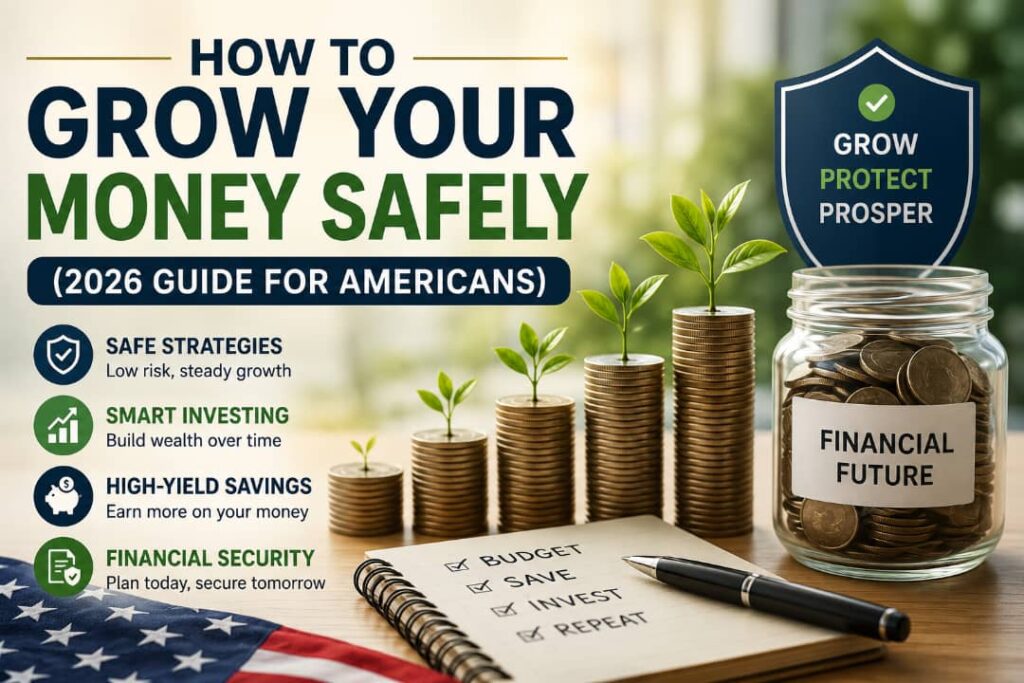
How to Grow Your Money Safely (2026 Guide for Americans)
Let’s be honest — when most people hear the word “investing,” they immediately think of stock market crashes, confusing financial jargon, or risky bets that only wealthy people understand. But growing your money safely doesn’t have to be stressful or complicated.
In reality, many financially successful Americans didn’t become wealthy overnight. They built their money slowly through smart habits, consistent investing, and patience. They avoided chasing “get rich quick” schemes and focused on long-term financial security instead.
If you’re trying to save for retirement, build passive income, beat inflation, or simply stop living paycheck to paycheck, learning how to grow your money safely is one of the best financial decisions you can make in 2026.
The good news? You don’t need to be a Wall Street expert to get started.
In this beginner-friendly guide, you’ll learn practical and low-risk ways Americans are building wealth today — plus several personal finance books that can help you grow financially while also serving as excellent affiliate products for your website.
Why Growing Your Money Safely Matters
A lot of Americans work hard for their money but unknowingly let it lose value over time.
How?
Because inflation quietly eats away at savings sitting in low-interest bank accounts. If inflation is rising at 3%–4% per year while your savings account earns less than 1%, your money is actually shrinking in purchasing power.
That’s why growing your money matters.
Safe wealth-building isn’t about gambling or becoming rich overnight. It’s about making smart financial decisions that help your money grow steadily while protecting your future.
When you grow your money safely, you can:
- Build long-term financial security
- Prepare for retirement
- Handle emergencies with less stress
- Create passive income
- Protect yourself from inflation
- Gain more freedom and peace of mind
Legendary investor Warren Buffett once said:
“The stock market is a device for transferring money from the impatient to the patient.”
That quote perfectly explains how real wealth is built — slowly and consistently.
1. Start With an Emergency Fund
Before you start investing, the smartest thing you can do is build an emergency fund.
Life happens. Cars break down. Medical bills show up unexpectedly. Jobs become unstable. Without savings, even small emergencies can push people into debt.
An emergency fund gives you breathing room.
Most financial experts recommend saving:
- 3–6 months of living expenses
- In a separate high-yield savings account
- Where it’s easy to access when needed
This money isn’t meant to make huge returns. Its job is to protect you financially during difficult moments.
One of the best beginner books for learning this strategy is The Total Money Makeover by Dave Ramsey. Basically, the book walks readers through budgeting, saving, and getting out of debt in a practical, step-by-step way.
2. Use High-Yield Savings Accounts
Traditional bank accounts often pay extremely low interest rates. That means your money mostly sits there doing very little.
High-yield savings accounts are different.
They typically offer better interest rates while still keeping your money safe and accessible.
Why many Americans prefer them:
- FDIC-insured protection
- Higher interest earnings
- Low risk
- Easy online banking access
These accounts are ideal for:
- Emergency funds
- Vacation savings
- Down payment savings
- Short-term financial goals
Will they make you rich? No.
But they’re one of the safest places to grow money without exposing yourself to major risk.
3. Invest in Index Funds
If you ask many financial experts for the safest long-term investing strategy, there’s a good chance they’ll mention index funds.
An index fund allows you to invest in hundreds of companies at once instead of relying on a single stock.
For example, many index funds track the S&P 500, which includes some of America’s largest companies.
That means your investment is automatically diversified.
Why people love index funds:
- Lower risk than individual stocks
- Lower investment fees
- Historically solid long-term returns
- Beginner-friendly investing
Instead of trying to “beat the market,” index fund investors focus on growing wealth steadily over time.
One highly recommended book on this topic is The Simple Path to Wealth by JL Collins. It explains investing in a simple, easy-to-understand way that beginners appreciate.
4. Take Advantage of Retirement Accounts
One of the biggest financial advantages Americans have is access to retirement investment accounts with tax benefits.
The two most popular options are the 401(k) and Roth IRA.
401(k)
A 401(k) is usually offered through employers.
Benefits include:
- Tax advantages
- Automatic investing from your paycheck
- Employer matching contributions
- Long-term compound growth
If your employer matches contributions, that’s essentially free money added to your retirement savings.
Roth IRA
A Roth IRA allows your investments to grow tax-free over time.
Benefits include:
- Tax-free withdrawals in retirement
- Flexible investment options
- Excellent for younger investors
Many financially successful Americans use both accounts together.
A great book that teaches modern money management strategies is I Will Teach You to Be Rich by Ramit Sethi. Despite the bold title, the advice is realistic, practical, and beginner-friendly.
5. Stay Away From “Get Rich Quick” Schemes
One of the fastest ways to lose money is chasing easy money.
Unfortunately, social media is full of people promising overnight success through:
- Day trading
- Crypto hype
- MLM businesses
- Penny stocks
- “Secret investment systems”
If something sounds too good to be true, it usually is.
Safe investing is often boring — and that’s completely okay.
Real wealth usually comes from:
- Patience
- Consistency
- Smart investing habits
- Long-term thinking
One of the best books about this mindset is The Psychology of Money by Morgan Housel. It explains how emotions and behavior often matter more than intelligence when it comes to money.
6. Diversify Your Investments
There’s a popular saying in investing:
“Don’t put all your eggs in one basket.”
That’s exactly what diversification means.
Instead of putting all your money into one investment, many Americans spread their money across different assets like:
- Index funds
- Bonds
- Retirement accounts
- Real estate
- Savings accounts
- Dividend stocks
Diversification helps reduce risk because if one investment performs poorly, the others may still perform well.
Even experienced investors like Warren Buffett prioritize protecting their money before chasing higher returns.
7. Invest Consistently Over Time
A lot of beginners wait for the “perfect” time to invest.
The problem is that nobody can predict the market perfectly.
That’s why many investors use a strategy called dollar-cost averaging.
This simply means investing a fixed amount regularly, no matter what the market is doing.
Examples:
- $100 every week
- $300 every month
- Automatic investments into index funds
This strategy helps remove emotion from investing and encourages long-term consistency.
And honestly, consistency usually matters more than timing.
8. Understand the Power of Compound Interest
Compound interest is where your money starts earning money on itself.
Over time, this creates powerful long-term growth.
Even small monthly investments can grow dramatically over decades if you stay consistent.
For example, someone investing regularly in their 20s often ends up with significantly more wealth than someone who waits until their 40s — even if the later investor contributes more money overall.
One influential beginner finance book covering this concept is Rich Dad Poor Dad by Robert Kiyosaki. While some ideas are debated, the book has inspired millions to think differently about money and investing.
9. Keep Investment Fees Low
Many people ignore investment fees because they seem small at first.
But over time, fees can quietly cost you thousands of dollars.
Common fees include:
- Financial advisor fees
- Mutual fund fees
- Trading commissions
- Management expenses
Low-cost index funds remain popular partly because they keep fees minimal.
And in long-term investing, keeping more of your money matters.
10. Never Stop Learning About Money
Financial education is one of the best investments you can make.
The more you learn about:
- Budgeting
- Investing
- Taxes
- Retirement planning
- Debt management
…the more confident and financially secure you become.
Some excellent personal finance books Americans still love in 2026 include:
These books are also excellent affiliate recommendations because they remain relevant year after year.
Common Mistakes People Make When Trying to Build Wealth
Even smart people make money mistakes sometimes.
Some of the most common include:
1.Spending More Than They Earn
Lifestyle inflation can destroy savings potential.
2.Waiting Too Long to Invest
Time is one of the biggest advantages in investing.
3.Panic Selling During Market Drops
Markets naturally rise and fall over time.
4.Ignoring Retirement Accounts
Many people miss valuable tax benefits.
5.Carrying High-Interest Debt
Credit card debt can quickly cancel out investment gains.
Building wealth safely is usually simple: Spend less than you earn, invest consistently, and stay
patient.
Can You Still Grow Money During a Recession?
Absolutely.
In fact, many experienced investors continue investing during recessions because prices are often lower.
While recessions can feel scary, they also create opportunities for long-term investors.
During uncertain times, focus on:
- Keeping emergency savings
- Staying diversified
- Avoiding emotional decisions
- Continuing long-term investing
Historically, the American stock market has recovered from every major downturn over time.
Final Thoughts
Growing your money safely isn’t about luck, secret tricks, or becoming an overnight millionaire.
It’s about making smart decisions consistently over time.
For most Americans, the safest path to long-term wealth includes:
- Emergency savings
- Index fund investing
- Retirement accounts
- Diversification
- Patience
- Ongoing financial education
The earlier you start, the better.
Even small investments made consistently can create meaningful wealth over the long run.
You don’t need to know everything to begin. You just need a simple plan and the willingness to stay consistent.
?? Frequently Asked Questions
1. What is the safest way to grow money in 2026?
The safest ways to grow money in 2026 include high-yield savings accounts, certificates of deposit (CDs), Treasury bonds, index funds, and retirement accounts like 401(k)s and IRAs. These options help Americans build wealth steadily while reducing unnecessary risk.
2. Can I grow my money without taking big risks?
Yes. You don’t need risky investments to build wealth. Many successful investors focus on long-term investing, diversification, and consistent contributions instead of chasing quick profits.
3. How much money do I need to start investing safely?
You can start with as little as $10 to $100. Many investment apps and brokerages now allow fractional investing, making it easier for beginners to invest safely with small amounts.
4. Are high-yield savings accounts worth it in 2026?
High-yield savings accounts are still one of the safest places to store emergency funds while earning better interest than traditional savings accounts. They are ideal for short-term savings goals and financial security.
5. What are the best low-risk investments for beginners?
Some beginner-friendly low-risk investments include:
- Index funds
- ETFs
- Treasury bonds
- Money market accounts
- CDs
- Dividend-paying stocks
These options are popular because they balance growth and stability.
6. Is investing in index funds safe?
Index funds are considered one of the safest long-term investment strategies because they spread your money across many companies instead of relying on a single stock. This helps reduce investment risk over time.
7. How can Americans beat inflation safely?
To beat inflation safely, many Americans combine:
- High-yield savings
- Diversified stock market investments
- Real estate investments
- Retirement accounts
- Treasury Inflation-Protected Securities (TIPS)
This helps money grow faster than rising living costs.
8. What is the difference between saving and investing?
Saving focuses on protecting your money for short-term goals, while investing focuses on growing your wealth over the long term. Most financial experts recommend doing both.
9. Are CDs a good investment in 2026?
Certificates of Deposit (CDs) can be a good low-risk investment if you want guaranteed returns and don’t need immediate access to your money before the maturity date.
10. How long does it take to grow wealth safely?
Growing wealth safely usually takes years, not weeks. Consistent investing, compound interest, and patience are key factors in building long-term financial security.
11. What is compound interest and why is it important?
Compound interest allows you to earn returns not only on your original money but also on the interest or profits you’ve already earned. Over time, compound growth can significantly increase your wealth.
12. Should beginners invest during a market downturn?
Many experts believe market downturns can create long-term buying opportunities. Beginners who invest consistently over time often benefit from dollar-cost averaging instead of trying to time the market.
13. What is dollar-cost averaging?
Dollar-cost averaging means investing a fixed amount regularly, regardless of market conditions. This strategy helps reduce emotional investing and lowers the risk of buying at the wrong time.
14. Is real estate still a safe investment in America?
Real estate can still be a relatively safe long-term investment if you choose the right location, manage debt carefully, and focus on cash flow instead of speculation.
15. What are the biggest mistakes people make when trying to grow money?
Common mistakes include:
- Chasing “get rich quick” schemes
- Investing emotionally
- Ignoring diversification
- Not having an emergency fund
- Waiting too long to start investing
16. Should I pay off debt before investing?
It depends on the interest rate. High-interest debt like credit cards should usually be paid off first. However, many Americans still invest while paying down manageable low-interest debt.
17. Are retirement accounts good for safe wealth growth?
Yes. Retirement accounts like 401(k)s and Roth IRAs offer tax advantages and long-term growth opportunities that help Americans build wealth more efficiently.
18. What are Treasury bonds and are they safe?
Treasury bonds are government-backed investments issued by the U.S. Treasury. They are considered among the safest investments because they are backed by the federal government.
19. Can passive income help grow wealth safely?
Yes. Passive income sources such as dividend stocks, rental properties, and bond interest can help create steady cash flow while building long-term financial stability.
20. What is the best financial habit for building wealth?
Consistency is one of the most powerful wealth-building habits. Regular saving, disciplined investing, avoiding unnecessary debt, and staying patient are key to long-term financial success.
21. Is it too late to start investing in your 30s, 40s, or 50s?
No. While starting early helps, many Americans successfully build wealth later in life by increasing contributions, investing consistently, and focusing on long-term financial planning.
22. How can beginners avoid investment scams?
To avoid scams:
- Research investments carefully
- Avoid guaranteed-return promises
- Use regulated financial institutions
- Verify advisors and platforms
- Stay cautious of social media hype
23. What role does diversification play in safe investing?
Diversification spreads your money across different assets like stocks, bonds, and real estate. This helps reduce losses if one investment performs poorly.
24. Are dividend stocks considered safe investments?
Many dividend stocks from established companies are viewed as safer investments because they can provide steady income and long-term growth potential.
25. What is the smartest way to start growing money today?
Start by:
- Building an emergency fund
- Paying off high-interest debt
- Investing consistently in diversified assets
- Using tax-advantaged retirement accounts
- Staying focused on long-term goals
This approach helps create financial security and sustainable wealth growth over time.
Disclosure: This article is for informational and educational purposes only and should not be construed as personalized financial advice. Always consult a licensed financial advisor before making investment decisions. This article contains affiliate links. We only recommend books we genuinely believe in.
Lorem ipsum dolor sit amet, consectetur adipiscing elit. Ut elit tellus, luctus nec ullamcorper mattis, pulvinar dapibus leo.