
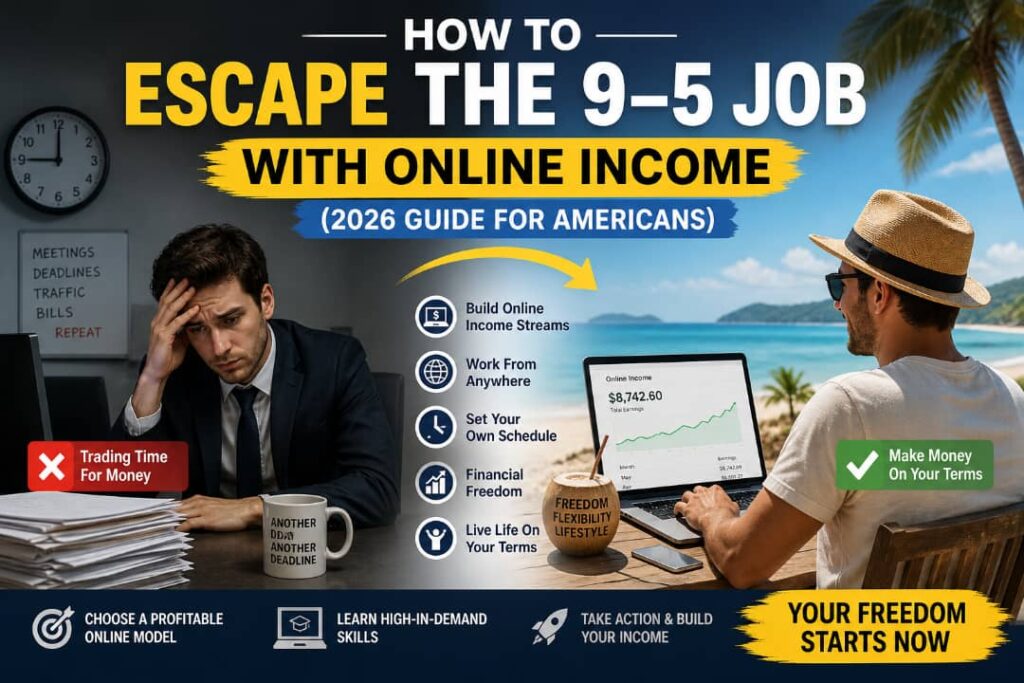
Let’s be real for a second.
That 6 a.m. alarm.
The rushed mornings.
The same commute.
The same desk.
The same routine… every single day.
For a lot of people in the U.S., the 9–5 isn’t just a job anymore—it feels like a loop you can’t escape.
And if you’ve ever caught yourself thinking, “There has to be more than this,” you’re not alone.
The good news? There is.
More Americans than ever are quietly building income online—on the side at first, then eventually replacing their jobs completely. What used to sound like a risky dream is now a very real path.
But here’s the part most people won’t tell you:
You don’t escape the 9–5 overnight. You build your way out of it.
Let’s talk about how that actually works.
Why the 9–5 Is Losing Its Grip
There was a time when the system made sense:
Go to school → get a job → stay there → retire.
Simple.
But today? Not so much.
Rent is high. Groceries cost more. Salaries don’t stretch like they used to. Honestly, and job security isn’t what it once was.
So people are adapting.
Instead of relying on one paycheck, they’re building multiple streams of income—especially online.
Because deep down, people aren’t just chasing money anymore.
They’re chasing:
- Time freedom
- Flexibility
- Control over their lives
The Real Shift: Thinking Like an Owner, Not an Employee
Before you even touch online income, there’s something more important you need to fix first—your mindset.
In Rich Dad Poor Dad, Robert Kiyosaki explains it simply:
Most people work for money. Wealthy people build things that make money for them.
That idea alone changes everything.
Then in The 4-Hour Workweek, Timothy Ferriss pushes it even further—design your life so your income isn’t tied to your time.
And in I Will Teach You to Be Rich, Ramit Sethi talks about building systems that run almost automatically.
Put all that together, and you get one clear message:
Freedom comes from systems—not effort alone.
The Best Ways to Start Earning Online (Without Overcomplicating It)
Let’s keep this practical. You don’t need 10 different income streams to start.
You just need one… done well.
1. Freelancing (Your Fastest Way to Cash)
If you want to make money quickly, this is your starting point.
You don’t need a fancy degree. Basically, you just need a skill people are willing to pay for.
That could be:
- Writing
- Designing
- Editing videos
- Managing social media
And yes—you can start as a beginner.
Freelancing works because it’s simple: You offer a service → someone pays you → you get experience → you charge more.
It’s not passive, but it’s powerful.
Think of it as your launchpad.
2. Affiliate Marketing (Earn While You Sleep… Eventually)
This is where things start to feel exciting.
Affiliate marketing is basically recommending products online and earning a commission when someone buys through your link.
You’ve probably already seen this:
- Blog reviews
- YouTube recommendations
- TikTok “must-have” products
Here’s the truth though—this part matters:
It’s slow at the beginning.
You might go weeks or even months without earning anything.
But once it clicks? It scales.
One blog post.
One video.
One link.
And it can keep earning long after you’ve created it.
3. Digital Products (Where Real Freedom Starts)
If you ask most people who’ve escaped the 9–5 what changed everything for them, many will point here.
Digital products.
That could be:
- An ebook
- A simple course
- Templates
- Guides
The beauty is this:
You create it once… and sell it over and over again.
No inventory.
No shipping.
No middleman.
It’s one of the closest things to true leverage online.
4. Content Creation (Your Long-Term Asset)
Let’s clear something up:
Content creation isn’t just about going viral.
It’s about building attention.
Because attention = opportunity.
When you consistently post content—on YouTube, TikTok, or a blog—you’re building something valuable:
An audience that trusts you.
And once you have that, you can monetize it in multiple ways:
- Ads
- Affiliate links
- Sponsorships
- Your own products
This is why content sits at the center of almost every successful online business today.
5. Online Business (Scaling Bigger)
Once you’ve got some experience and income coming in, you can step into bigger plays like:
- E-commerce
- Print-on-demand
- Dropshipping
This is where you move from side hustle… to actual business.
But here’s the key:
Don’t start here.
Build skills first. Learn how money flows online. Then scale.
The Strategy That Actually Works (Most People Miss This)
A lot of people fail because they treat online income like a lottery ticket.
Try something → get no results → quit.
But the people who win? They stack things.
It usually looks like this:
- Start freelancing (quick money)
- Build content (visibility)
- Add affiliate links (monetization)
- Create a digital product (scale)
- Automate where possible
Step by step.
No rush. No chaos.
Just progress.
A Simple 90-Day Plan to Get Started
If you’re serious, here’s a realistic way to begin.
Month 1: Make Your First Dollar
Pick one skill. Offer it. Get paid.
Don’t overthink it.
Month 2: Start Showing Up Online
Create content around what you’re learning or doing.
Keep it simple. Stay consistent.
Month 3: Add Income Streams
Introduce affiliate links. Test a small digital product.
Now you’re building—not just earning.
Mistakes That Keep People Stuck
Let’s save you some frustration.
- Chasing quick money → It doesn’t exist
- Trying everything at once → You burn out
- Quitting too early → You never see results
- Avoiding skill-building → You stay stuck
If you avoid these, you’re already ahead of most people.
What People Who Escape the 9–5 Do Differently
They’re not special. They just do a few things consistently:
- They stick with one path longer than others
- They focus on learning, not shortcuts
- They reinvest what they earn
- They build systems over time
And most importantly…
They don’t rely on motivation. As it turns out, they rely on discipline.
So… Is This Actually Realistic?
Yes.
But let’s not pretend it’s instant.
A realistic timeline looks like this:
- First 3 months → You make your first money
- 3–6 months → You build consistency
- 6–18 months → You can replace your income
Some people move faster. Some slower.
But the path works—if you do.
Final Thoughts: You Don’t Quit… You Replace
Escaping the 9–5 isn’t about waking up tomorrow and quitting your job.
That’s risky.
Instead, you build something on the side… until it becomes strong enough to stand on its own.
Then one day, you realize:
You don’t need your job anymore.
That’s the goal.
Not just more money—but more control over your time, your decisions, and your life.
Quick Reality Check
- This won’t happen overnight
- It will feel slow at first
- You will doubt yourself
But if you stay consistent?
It works.
Frequently Asked Questions (FAQs).
1. Is it really possible to escape a 9–5 job with online income?
Yes—it’s absolutely possible, but it takes time, consistency, and the right strategy. Most people start part-time and gradually build income streams until they can replace their job.
If you’re just starting out, a structured program like Freedom Breakthrough 3.0 Course can help you skip months of confusion by showing you step-by-step how online income actually works.
2. How long does it take to replace a full-time job with online income?
For most beginners, it takes 6 to 18 months to fully replace a 9–5 income. Freelancing can bring in money quickly, while passive income streams take longer to build.
To speed things up, many people use tools like Bluehost Hosting to launch a blog quickly and start monetizing with affiliate links early.
3. What is the best online income stream for beginners in 2026?
Freelancing is the easiest entry point because you can earn immediately. After that, affiliate marketing and content creation are great for long-term growth.
A beginner-friendly platform like Fiverr Platform makes it easy to start offering services even if you have little experience.
4. Do I need special skills to start making money online?
No—you can start with basic skills and improve over time. The key is learning high-income skills like writing, marketing, or design.
Courses on platforms like Skillshare Subscription can help you quickly build skills that people are willing to pay for.
5. How much money can I realistically make online?
Beginners typically earn $300–$1,000/month, while experienced creators can make $5,000+ per month or more.
To scale your income, tools like ConvertKit Email Marketing help you build an audience and turn visitors into paying customers.
6. Is affiliate marketing still profitable in 2026?
Yes—affiliate marketing is still growing and remains one of the best ways to build semi-passive income online.
If you want an all-in-one solution, platforms like Systeme.io allow you to build funnels, collect emails, and promote products in one place.
7. Can I start while working a full-time job?
Yes—and that’s actually the smartest approach. You can build your online income on evenings and weekends without risking your financial stability.
To stay organized, productivity tools like Notion App help you manage tasks, content, and income goals efficiently.
8. What are the biggest mistakes beginners make?
Common mistakes include:
- Expecting fast results
- Trying too many things at once
- Giving up too early
Following proven frameworks from books like Rich Dad Poor Dad can help you focus on building assets instead of chasing quick money.
To avoid trial-and-error, structured programs like Legendary Marketer Training can guide you
step-by-step.
9. Do I need money to start making money online?
No—you can start with free tools. However, investing in the right tools can save you time and accelerate your results.
For example, using a website builder like WordPress Platform allows you to create a professional site that you fully control.
10. What is the fastest way to make money online as a beginner?
Freelancing is the fastest because you’re directly exchanging a service for money.
You can start immediately by creating gigs on Upwork Platform and applying for beginner-friendly jobs.
11. How do I stay motivated while building online income?
Motivation fades—discipline and systems keep you going. Set small daily goals and track your progress.
Using planners or digital tools like ClickUp Software can help you stay consistent and focused.
12. When should I quit my 9–5 job?
You should only quit when your online income consistently covers 70–100% of your expenses for several months.
To manage your finances wisely, tools like YNAB Budgeting App help you track income and prepare for the transition.
13. Can online income become passive?
Yes—but most income streams start active and become passive over time.
For example, a blog post can earn for years if it ranks on search engines. Using SEO tools like Ubersuggest Tool helps you create content that attracts long-term traffic.
14. What is the safest way to transition out of a 9–5 job?
The safest approach is:
- Build income on the side
- Save 3–6 months of expenses
- Transition gradually
Savings tools like Acorns App can help you build a financial cushion while growing your online income.
15. What tools do I need to start making money online?
At minimum, you need:
- A laptop
- Internet connection
- A platform (blog, YouTube, etc.)
To get started quickly, a hosting + website combo like Hostinger Hosting makes it easy to launch your online presence in minutes.