
By staff | Last Updated: June 2026
6-minute read
Let’s Talk About Your Money for a Second
Most people don’t wake up excited about “portfolio diversification.”
It sounds technical. A bit stiff. Maybe even something only Wall Street professionals worry about.
But here’s the truth: if you’re investing in the U.S. stock market, even just through a retirement account, diversification is quietly doing a lot of heavy lifting in the background.
Or at least, it should be.
Because without it, your financial future can swing wildly depending on just one company, one sector, or one bad year in the market. And nobody wants that kind of stress.
So in this guide, we’ll break down how to build a diversified investment portfolio in a way that actually makes sense in real life. Whether you’re investing for retirement, financial freedom, or long-term wealth in America, this is your foundation.
What a Diversified Investment Portfolio Really Means
At its core, diversification is simple:
Don’t rely on one investment to carry your entire financial future.
Instead, you spread your money across different types of assets so that when one goes down, others can help balance things out.
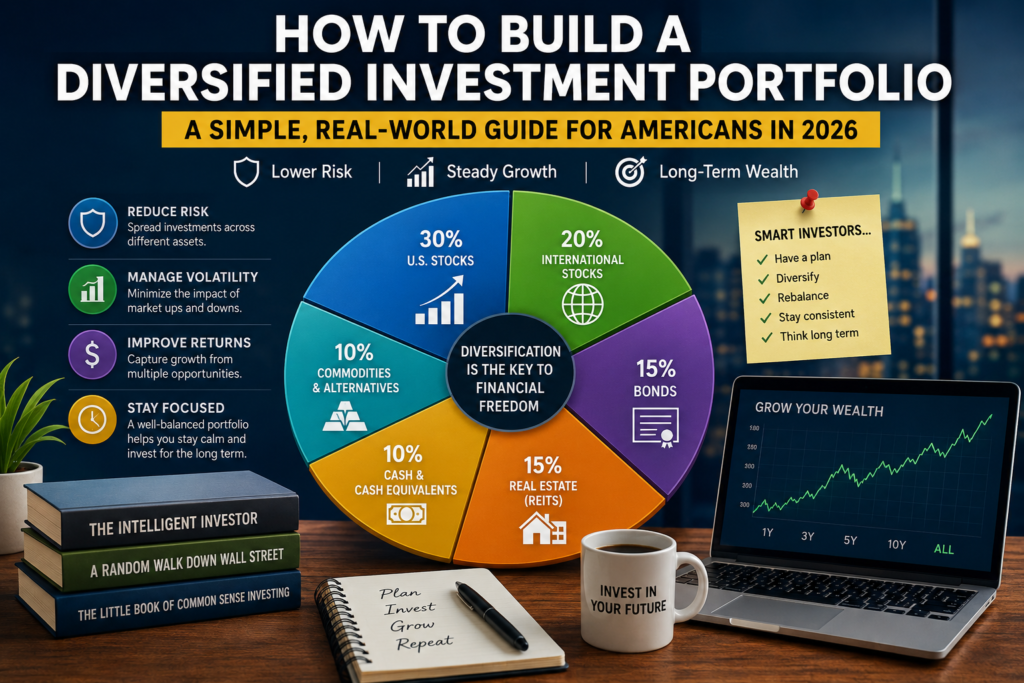
A solid diversified portfolio might include:
- U.S. stocks
- International stocks
- Bonds
- Real estate (or REITs)
- ETFs and index funds
- Cash savings
Think of it like building a team. You wouldn’t hire ten people who all do the exact same job. You’d want different skills working together.
Investing works the same way.
Why Diversification Matters So Much (Especially in America)
The U.S. market has been strong over the long term—but it’s never smooth.
We’ve seen major crashes and corrections:
- The Dot-Com Bubble collapse
- The 2008 financial crisis
- The COVID-19 market shock
Each time, investors who were overexposed to one sector or poorly diversified felt the pain the most.
Here’s what diversification does for you:
It reduces emotional stress
When your entire portfolio isn’t tied to one stock, you panic less during downturns.
It smooths out returns
Some assets fall while others rise. The ride becomes less extreme.
It protects long-term wealth
You don’t just chase gains, you survive long enough to benefit from compounding.
As Burton Malkiel explains in A Random Walk Down Wall Street, markets are unpredictable in the short term, which makes spreading your risk one of the smartest long-term strategies.
Step 1: Start With Asset Allocation (This Is the Real Foundation)
Before you pick stocks or ETFs, you need a plan for how your money is divided.
This is called asset allocation, and it matters more than most beginners realize.
William Bernstein, in The Intelligent Asset Allocator, emphasizes that how you divide your money is often more important than what you invest in.
Here’s a simple breakdown:
Aggressive Portfolio (younger investors)
- 90% stocks
- 10% bonds
Balanced Portfolio
- 70% stocks
- 25% bonds
- 5% cash
Conservative Portfolio (closer to retirement)
- 50% stocks
- 40% bonds
- 10% cash
There’s no perfect formula. Your age, income stability, and risk tolerance all matter.
But the key idea is simple: don’t guess, you plan.
Step 2: Don’t Just Buy Stocks—Diversify Across Them
A lot of beginners think owning 10 stocks means they’re diversified.
Not really.
If all 10 are tech companies, you’re still heavily exposed to one sector.
A properly diversified stock portfolio spreads across:
Technology
AI, cloud computing, semiconductors—high growth, but volatile.
Healthcare
More stable, essential services that perform even in downturns.
Financials
Banks, insurance companies, fintech—tied to economic cycles.
Consumer Goods
Everyday products people buy no matter what the economy is doing.
Energy & Industrials
Influenced by inflation, infrastructure, and global demand.
The goal isn’t to predict winners. It’s to avoid relying too heavily on any single story.
Step 3: Index Funds and ETFs Make Life Easier
If there’s one tool that makes diversification almost effortless, it’s index funds and ETFs.
Instead of picking individual stocks, you buy a whole basket of companies in one move.
For example:
- S&P 500 index funds give you exposure to 500 large U.S. companies
- Total stock market funds go even broader
- International ETFs spread your money across global markets
- Bond ETFs add stability and income
John Bogle, founder of Vanguard and author of The Little Book of Common Sense Investing, famously argued that most investors are better off owning the entire market at low cost.
And honestly, he has a point.
For many Americans, index funds are the simplest path to real diversification.
Step 4: Don’t Ignore International Markets
A common mistake? Staying 100% in U.S. investments.
Yes, America is strong economically. But other regions grow differently and don’t always move in the same direction.
International exposure gives you access to:
- Europe
- Asia
- Emerging markets
- Global innovation trends
When the U.S. market slows down, other regions might outperform, and vice versa.
Diversifying globally is like adding extra safety rails to your portfolio.
Step 5: Bonds Bring Stability When Markets Get Shaky
Stocks are for growth. Bonds are for balance.
Bonds are basically loans you give to governments or companies in exchange for interest payments.
They’re not exciting, but that’s kind of the point.
Types include:
- U.S. Treasury bonds (very safe)
- Corporate bonds (higher yield, more risk)
- Municipal bonds (tax advantages in some cases)
As you get older, increasing your bond allocation can help protect your gains from market volatility.
Think of bonds as the “calm voice” in your portfolio when stocks get noisy.
Step 6: Real Estate Adds a Different Layer of Diversification
Real estate behaves differently from stocks, which makes it valuable in a diversified portfolio.
You have options like:
Rental properties
Provide monthly cash flow, but require management.
REITs (Real Estate Investment Trusts)
Let you invest in real estate without owning physical property.
Real estate funds
Offer broad exposure to commercial and residential markets.
In The Millionaire Real Estate Investor, Gary Keller highlights how real estate can build long-term wealth when used strategically alongside other investments.
Step 7: Keep Some Cash (Yes, Even in Investing)
Cash isn’t “lazy money.” It’s flexibility.
A good cash reserve helps you:
- Handle emergencies
- Avoid selling investments at the wrong time
- Take advantage of market dips
Most financial planners suggest 3–6 months of expenses in a high-yield savings account.
It’s not exciting, but it’s incredibly practical.
Step 8: Rebalancing Keeps Everything on Track
Over time, your portfolio naturally drifts.
For example:
- Stocks grow faster → they take up more of your portfolio
- Bonds lag → they shrink in percentage
That changes your risk level without you realizing it.
Rebalancing simply means adjusting back to your original plan.
Most investors do this once or twice a year.
It’s not about timing the market. It’s about staying disciplined.
Common Mistakes That Hurt Diversification
Let’s keep it real, here are mistakes many investors make:
Thinking “more stocks = diversification”
Not true if they’re all in one sector.
Chasing hot trends
Today’s winning sector can become tomorrow’s biggest loser.
Over-investing in your employer’s stock
Risky because your income and investments depend on the same company.
Ignoring international exposure
A big missed opportunity for balance.
A Simple Beginner-Friendly Portfolio Example
If you’re just starting out, here’s a clean structure:
- 50% U.S. index fund
- 20% international ETF
- 15% bond fund
- 10% REITs
- 5% cash
It’s not flashy. But it’s stable, diversified, and built for long-term growth
Recommended Books for Diversified Investing
If you want to go deeper, these books are worth your time:
📘 The Intelligent Investor by Benjamin Graham
One of the most important investing books ever written.
It teaches long-term value investing principles, risk management, and disciplined decision-making.
👉 Best for: Building strong investing foundations
📗 A Random Walk Down Wall Street by Burton Malkiel
This book explains why markets are hard to beat and why diversification and index investing work so well.
👉 Best for: Understanding index funds and passive investing
📕 The Little Book of Common Sense Investing by John Bogle
Written by the founder of Vanguard, this book strongly advocates low-cost index funds as the simplest path to wealth.
👉 Best for: Beginner investors and ETF/index fund strategies
📙 The Intelligent Asset Allocator by William Bernstein
A deeper dive into asset allocation and how to structure a truly diversified portfolio.
👉 Best for: Serious investors optimizing portfolio structure
📒 The Simple Path to Wealth by JL Collins
A highly readable guide focused on building wealth using simple index fund investing strategies.
👉 Best for: Beginners aiming for financial independence
📓 The Millionaire Real Estate Investor by Gary Keller
Focuses on how real estate can be used as part of a long-term wealth-building strategy.
👉 Best for: Investors interested in property diversification
Final Thoughts: Keep It Simple, Stay Consistent
Building a diversified investment portfolio isn’t about predicting the future.
It’s about preparing for uncertainty.
You don’t need to chase every hot stock or time every market move. Instead, focus on spreading your investments, staying disciplined, and letting time do the heavy lifting.
Because in investing, the real advantage isn’t intelligence or luck.
It’s patience, structure, and staying invested long enough for compounding to work.
And that’s something almost anyone can build.
📌 Frequently Asked Questions (FAQs)
1. What does it mean to have a diversified investment portfolio?
A diversified portfolio means spreading your money across different assets like stocks, bonds, real estate, and ETFs so you don’t rely on one investment. This helps reduce risk and smooth out returns over time.
2. Why is diversification important for American investors?
Diversification protects investors from market volatility. If one sector (like tech) drops, other areas (like healthcare or bonds) may remain stable or even grow, helping balance losses.
3. What is the best asset allocation for beginners?
There is no single “best” allocation, but a common beginner-friendly mix is:
- 60–70% U.S. stocks
- 20–30% bonds
- 5–10% international investments or REITs
Your age, risk tolerance, and goals should guide your allocation.
4. Are index funds good for diversification?
Yes, index funds are one of the easiest ways to diversify. A single S&P 500 index fund gives exposure to 500 major U.S. companies, instantly spreading your risk.
5. How many stocks should I own to be diversified?
There is no fixed number, but most experts suggest that true diversification comes from owning multiple sectors and asset classes, not just many individual stocks. ETFs often solve this automatically.
6. Should I include international investments in my portfolio?
Yes. International investments help protect your portfolio from being too dependent on the U.S. economy and give exposure to global growth opportunities.
7. What role do bonds play in a diversified portfolio?
Bonds add stability and income. When stock markets fall, bonds often hold steady or rise, helping reduce overall portfolio volatility.
8. Is real estate necessary for diversification?
Not required, but highly beneficial. Real estate (or REITs) adds a different asset class that can hedge against inflation and provide steady cash flow.
9. How often should I rebalance my portfolio?
Most investors rebalance once or twice a year. This keeps your original asset allocation intact and prevents overexposure to one asset class.
10. What is the biggest mistake beginners make when diversifying?
The most common mistake is thinking they are diversified when they only own similar assets, for example, multiple tech stocks. True diversification requires variety across sectors and asset types.
11. Can I build a diversified portfolio with little money?
Yes. ETFs and fractional shares allow beginners to build a diversified portfolio with even small amounts like $50–$100 per month.
12. Is diversification enough to guarantee profits?
No. Diversification reduces risk but does not eliminate losses. However, it significantly improves long-term consistency and survival in the market.
Disclosure: This article is for informational and educational purposes only and should not be construed as personalized financial advice. Always consult a licensed financial advisor before making investment decisions. This article contains affiliate links.We only recommend books we genuinely believe in.