
Let’s be real for a second—when people first hear about affiliate marketing, it usually sounds like one of those “make money while you sleep” promises that never quite add up. Either that, or it feels confusing and technical.
The truth? It’s neither magic nor overly complicated. Affiliate marketing does work in 2026, especially in the United States—but only if you understand what’s actually going on behind the scenes and approach it with the right mindset.
So instead of throwing jargon at you, let’s walk through this like two people having a normal conversation.
What Is Affiliate Marketing (In Plain English)?
At its simplest, affiliate marketing is just recommending products online and earning a commission when someone buys through your link.
That’s it.
Think of it like this:
You’re the friend who always knows the best apps, tools, or products. Now imagine getting paid every time someone takes your recommendation.
For example:
- You write about a budgeting app on your blog
- Someone clicks your special link
- They sign up or buy
- You earn a small commission
No inventory. No packaging. No dealing with customer complaints.
You’re simply connecting people to things they already need.
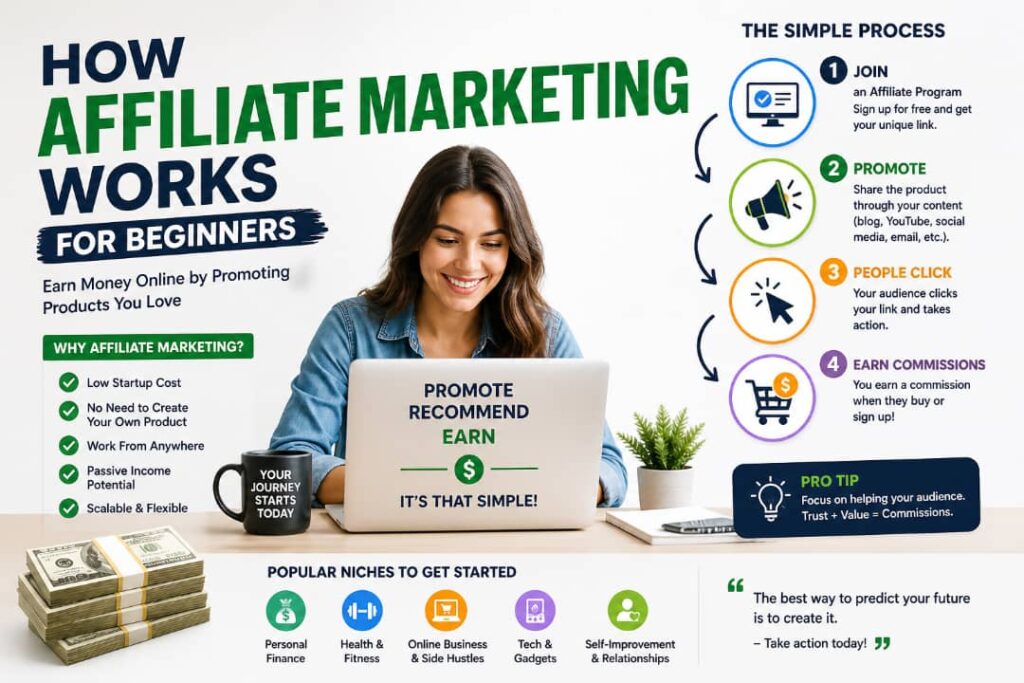
How It Actually Works (Step-by-Step, No Confusion)
Let’s break it down in a way that actually makes sense:
Step 1: You sign up for an affiliate program
Companies give regular people (like you) the chance to promote their products. Basically,
platforms like Amazon or other affiliate networks make this easy.
Step 2: You get your unique link
This is how the company knows a sale came from you.
Step 3: You share it through content
This could be:
- A blog post
- A YouTube video
- A TikTok clip
- Even an email
Step 4: Someone clicks and trusts you enough to act
This part is important—it’s not just about clicks, it’s about trust.
Step 5: You get paid
If they buy (or sometimes just sign up), you earn a commission.
Simple process. As it turns out, not always easy—but definitely simple.
Why Affiliate Marketing Is Still Booming in the U.S.
There’s a reason so many beginners are getting into this in 2026.
- You don’t need much money to start
- You don’t need to create your own product
- You can do it part-time
- And it can grow over time
But the biggest reason?
People already trust online recommendations.
Before buying anything, most Americans:
- Read reviews
- Watch YouTube videos
- Search “best X for Y”
Affiliate marketing fits perfectly into that behavior.
Choosing a Niche (Don’t Skip This Part)
This is where a lot of beginners go wrong.
They chase “what makes money” instead of asking:
“What can I actually stick with?”
A niche is just your focus area.
Good niches usually:
- Solve real problems
- Have products people are already buying
- Are things you won’t get bored talking about
Some solid examples:
- Personal finance
- Fitness and health
- Side hustles and online income
- Tech and gadgets
- Self-improvement
For instance, books like The Total Money Makeover or I Will Teach You to Be Rich are often promoted in the finance niche—not because they’re trendy, but because people are actively looking for solutions.
Traffic: The Part No One Can Ignore
Here’s the honest truth:
If nobody sees your content, nothing else matters.
No traffic = no clicks = no income.
So how do people actually get traffic?
1. Google (SEO)
This means creating content people are already searching for.
Examples:
- “Best budgeting apps in the U.S.”
- “How to save $1,000 fast”
It takes time, but once it works, it can bring consistent free traffic.
2. Social Media
Platforms like TikTok, Instagram, and YouTube are huge right now.
And you don’t need to be perfect—you just need to be helpful.
Simple content works:
- Quick reviews
- “Top 5 tools”
- Personal experiences
3. Email (Underrated but Powerful)
This is where things get interesting.
When someone joins your email list, you’re no longer chasing attention—you have it.
Over time, that trust turns into clicks and commissions.
Content That Actually Makes Money
Here’s a mistake almost everyone makes at the beginning:
They focus on getting views instead of getting results.
You don’t need millions of views—you need the right kind of content.
Content that converts usually looks like:
- Honest product reviews
- Comparisons (“this vs that”)
- Step-by-step guides
- Lists (“top tools for beginners”)
For example, instead of writing: “How to make money online”
Try: “Best affiliate programs for beginners in the U.S. (2026)”
One attracts curiosity. The other attracts buyers.
How You Actually Get Paid
Not all affiliate programs pay the same way.
Here’s what you’ll typically see:
- Percentage-based: You earn a cut of the sale
- Flat fee: You get paid a fixed amount
- Recurring income: You earn monthly as long as the customer stays
That last one? That’s where things start to feel like real income over time.
Tools (Keep It Simple)
You really don’t need much to start:
- A platform (blog, YouTube, or social media)
- A way to find content ideas
- A way to share links
- Optional: email list
A lot of beginners get stuck trying to build the “perfect setup.”
You don’t need perfect—you need to start.
Mistakes That Quietly Kill Progress
Let’s be honest—most people don’t fail because affiliate marketing doesn’t work.
They fail because of these:
- Expecting quick money
- Promoting everything instead of focusing
- Sounding too salesy
- Ignoring long-term strategies like SEO
- Giving up too soon
That last one is the most common.
What You Can Realistically Expect
No hype here.
A typical beginner journey might look like:
- First few months: learning, little to no income
- 3–6 months: small wins
- 6–12 months: things start building
It’s not instant—but it’s very real if you stay consistent.
Trust Is Everything
At the end of the day, affiliate marketing is not about links—it’s about trust.
People don’t click because of your link.
They click because they believe you.
The best affiliates:
- Share honest opinions
- Recommend things they actually believe in
- Focus on helping, not just selling
Books like Your Money or Your Life emphasize thoughtful, intentional decisions—which is exactly how good affiliate marketing should feel.
Is It Worth It?
Yes—but only if you treat it seriously.
It’s not:
- A shortcut to quick money
- Effortless passive income
- Something you try for a week
It is:
- A real online business model
- Flexible and beginner-friendly
- Something that grows over time
A Simple Way to Start (Without Overthinking)
If you’re starting from zero, keep it basic:
- Pick something you’re interested in
- Choose one platform (don’t try everything at once)
- Join a couple of affiliate programs
- Create helpful content consistently
- Learn as you go
- Stay patient
That’s honestly enough to get going.
Final Thoughts
Affiliate marketing isn’t some hidden secret—it’s just a modern way of recommending products and earning from it.
And in a world where people are constantly searching, comparing, and buying online, that skill is only becoming more valuable.
If you focus on helping people, stay consistent, and don’t chase shortcuts, this can turn into something meaningful over time.
Frequently Asked Questions (FAQs)
1. What is affiliate marketing in simple terms?
Affiliate marketing is when you promote a product or service online and earn a commission when someone buys through your link. You don’t create the product—you just recommend it.
2. Is affiliate marketing legit in the United States?
Yes, affiliate marketing is 100% legal and widely used by major companies in the U.S. Brands like Amazon, Walmart, and many online platforms rely on affiliates to promote their products.
3. Do I need money to start affiliate marketing?
Not necessarily. You can start with free platforms like TikTok, Instagram, or YouTube. However, investing in tools like a website or email list can help you grow faster.
4. How do beginners get approved for affiliate programs?
Most beginner-friendly programs are easy to join. Some may ask for:
- A website or social media page
- Basic content related to their niche
Start with platforms that don’t require strict approval, then scale up.
5. How much can a beginner realistically make?
It depends on your effort and consistency. Most beginners earn:
- $0–$100 in the first few months
- $100–$1,000/month after learning the basics
Long-term, it can grow much higher.
6. How long does it take to make money with affiliate marketing?
Typically, it takes 3 to 6 months to see your first results. Some people take longer—it depends on your strategy and consistency.
7. What are the best niches for affiliate marketing in 2026?
Popular and profitable niches include:
- Personal finance
- Health and fitness
- Online business and side hustles
- Technology and gadgets
- Self-improvement
Books like The Total Money Makeover and I Will Teach You to Be Rich are great examples of products often promoted in the finance niche.
8. Do I need a website to do affiliate marketing?
No, you don’t need a website. Many beginners start with:
- TikTok
- YouTube
However, having a website helps with long-term growth and SEO traffic.
9. What is the best platform for beginners?
There’s no single “best,” but here’s a simple guide:
- TikTok: Fast growth, easy to start
- YouTube: Long-term traffic
- Blogging (SEO): Passive income over time
Pick one and focus on it first.
10. How do I get people to click my affiliate links?
You don’t just drop links—you provide value first.
People click when you:
- Solve a problem
- Share real experiences
- Give honest recommendations
Trust drives clicks.
11. Can I do affiliate marketing without showing my face?
Yes. Many people succeed using:
- Voiceovers
- Screen recordings
- Blog posts
- AI-generated content (with value added)
You don’t have to be on camera to succeed.
12. What is SEO and why is it important?
SEO (Search Engine Optimization) is how your content shows up on Google.
It’s important because it brings free, consistent traffic to your content over time.
13. What mistakes should beginners avoid?
Common mistakes include:
- Expecting fast money
- Promoting too many products
- Not building trust
- Quitting too early
Consistency beats shortcuts.
14. Do I need to disclose affiliate links?
Yes. In the U.S., the Federal Trade Commission (FTC) requires you to disclose affiliate relationships.
A simple disclaimer like “I may earn a commission at no extra cost to you” is enough.
15. What types of affiliate commissions are there?
There are three main types:
- Percentage-based (earn a % of each sale)
- Fixed commissions (flat fee per sale or signup)
- Recurring commissions (monthly income from subscriptions)
Recurring commissions are often the most powerful long-term.
16. Can affiliate marketing become a full-time income?
Yes, but it takes time and effort. Many people start it as a side hustle and grow it into a full-time business.
17. How do I choose the right products to promote?
Pick products that:
- Solve real problems
- Have good reviews
- You would personally recommend
For example, mindset-focused books like Your Money or Your Life align well with audiences interested in financial freedom.
18. Is affiliate marketing passive income?
Not at the beginning. You’ll need to create content and build trust first.
Over time, some content can generate income passively—but only after upfront effort.
19. How many affiliate programs should I join as a beginner?
Start with 1–3 programs.
Too many options can overwhelm you and reduce focus.
20. What’s the fastest way to succeed in affiliate marketing?
There’s no “fastest” shortcut, but the most effective approach is:
- Pick one niche
- Focus on one platform
- Create helpful content consistently
- Learn from what works
Simple—but not easy.