
By staff | Last Updated: June 2026
7-minute read
If you’ve been looking for a simple way to start investing, you’ve probably heard someone mention ETFs. Financial advisors recommend them. Retirement experts talk about them constantly. Even many successful investors use them as the foundation of their portfolios.
So what’s all the excitement about?
The truth is that ETFs have made investing easier, cheaper, and more accessible than ever before. You no longer need to spend hours researching individual stocks or trying to predict which company will be the next big winner. With a single ETF, you can own pieces of hundreds, or even thousands of companies.
That’s a pretty powerful idea.
Whether you’re saving for retirement, building long-term wealth, or just getting started with investing, this guide will walk you through everything you need to know about ETF investing in a way that’s easy to understand.
Let’s dive in.
What Is an ETF?
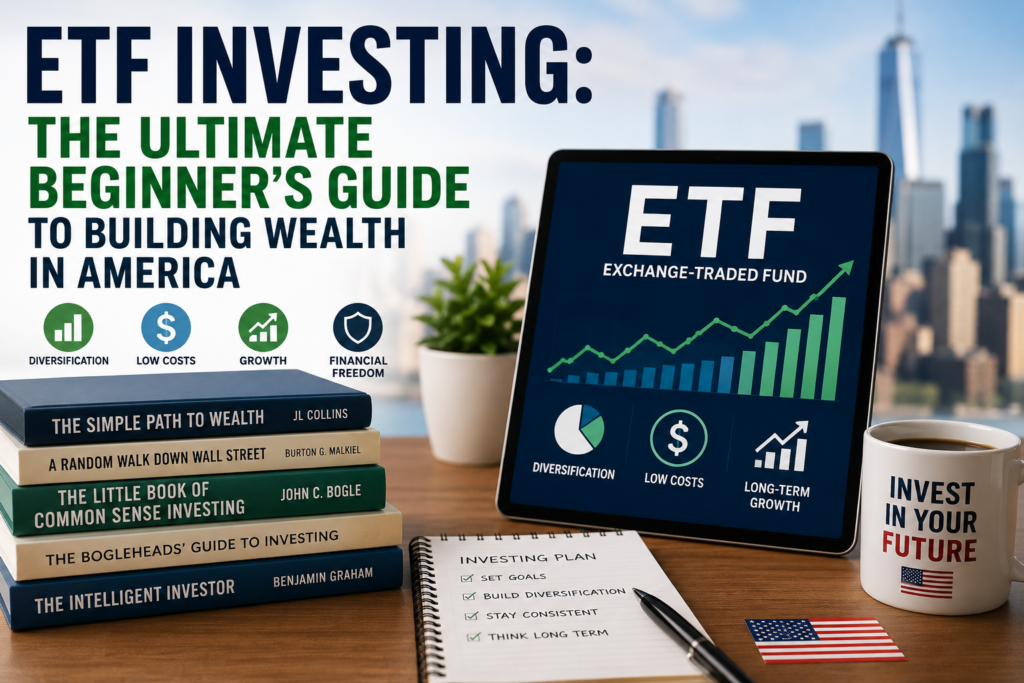
ETF stands for Exchange-Traded Fund.
The easiest way to think about an ETF is as a basket of investments.
Instead of buying stock in just one company, an ETF allows you to buy a collection of investments all at once. Depending on the ETF, that basket might contain hundreds of stocks, bonds, or other assets.
Imagine walking into a grocery store. You could buy one apple, or you could buy an entire fruit basket containing apples, oranges, grapes, and bananas.
Buying an individual stock is like buying one apple.
Buying an ETF is like buying the whole basket.
This built-in diversification is one of the biggest reasons ETFs have become so popular among American investors.
How ETFs Work
Most ETFs are designed to track the performance of a specific market index, sector, or investment theme.
For example, some ETFs follow the S&P 500, which includes 500 of America’s largest companies. Others focus on technology stocks, healthcare companies, dividend-paying businesses, bonds, or international markets.
When the investments inside the ETF rise in value, the ETF generally rises as well. If those investments decline, the ETF typically follows.
Unlike traditional mutual funds, ETFs trade throughout the day on stock exchanges. That means you can buy or sell them whenever the market is open, just like you would with a regular stock.
For many investors, that combination of simplicity and flexibility is hard to beat.
Why So Many Investors Love ETFs
ETFs didn’t become popular by accident. They solve many of the challenges that investors used to face.
Let’s look at some of their biggest advantages.
Instant Diversification
One of the golden rules of investing is not putting all your eggs in one basket.
When you buy a single stock, your success depends heavily on one company. If that company struggles, your investment may suffer.
With an ETF, your money is spread across many companies.
Even if a few businesses perform poorly, the others may help balance things out.
This diversification can reduce risk and make investing less stressful.
Low Costs
Fees might seem small, but over decades they can have a huge impact on your wealth.
Many ETFs have extremely low expense ratios, often less than 0.10% annually.
That means more of your money stays invested and continues growing through compound returns.
The late investing pioneer John Bogle spent much of his career teaching investors that keeping costs low is one of the simplest ways to improve long-term performance.
His advice remains just as relevant today.
Beginner-Friendly
Let’s be honest. Most people don’t have the time, or interest to analyze financial statements, earnings reports, and stock valuations every weekend.
ETFs simplify the process.
Instead of trying to identify the next Amazon or Apple, you can invest in broad sections of the market and let time do the heavy lifting.
That’s why ETFs are often recommended for beginners.
Liquidity and Flexibility
Because ETFs trade on stock exchanges, you can buy and sell shares throughout the trading day.
This gives investors flexibility and transparency that many traditional investment products don’t offer.
Tax Efficiency
Many ETFs are structured in a way that helps reduce taxable distributions compared to actively managed mutual funds.
For investors using taxable brokerage accounts, this can potentially mean keeping more of their investment gains over time.
Different Types of ETFs You Should Know
One of the best things about ETFs is the variety available.
There’s an ETF for almost every investment goal.
Broad Market ETFs
These funds track large portions of the stock market.
They often include hundreds or thousands of companies and are frequently considered the ideal starting point for beginners.
If you’re looking for simplicity, broad-market ETFs deserve serious consideration.
Dividend ETFs
Dividend ETFs focus on companies that regularly share profits with shareholders through dividend payments.
Many investors like these funds because they provide income while still offering growth potential.
They’re particularly popular among retirees and income-focused investors.
Bond ETFs
Stocks get most of the attention, but bonds play an important role too.
Bond ETFs invest in government bonds, corporate bonds, or a combination of both.
They generally offer lower volatility and can help stabilize a portfolio during market downturns.
International ETFs
The United States has many outstanding companies, but opportunities exist beyond America’s borders as well.
International ETFs allow investors to gain exposure to businesses across Europe, Asia, Latin America, and other regions.
Adding international investments can increase diversification and reduce dependence on a single country’s economy.
Sector ETFs
These ETFs focus on specific industries such as:
- Technology
- Healthcare
- Financial services
- Energy
- Consumer goods
Sector ETFs can offer higher growth potential, but they usually come with higher risk because they’re concentrated in one area of the economy.
Commodity ETFs
Commodity ETFs invest in assets like gold, silver, oil, or agricultural products.
Some investors use these funds as a hedge against inflation or to add another layer of diversification to their portfolios.
How to Choose Your First ETF
Walking into the ETF market for the first time can feel overwhelming. There are thousands of options available.
Fortunately, choosing your first ETF doesn’t need to be complicated.
Start by focusing on a few key factors.
Keep an Eye on Fees
A lower expense ratio means less money leaving your account each year.
Over the long run, even small differences in fees can add up to thousands of dollars.
Look for Broad Diversification
Many beginners are best served by ETFs that cover large portions of the market rather than narrow, specialized niches.
Broad diversification can help smooth out the investment journey.
Check Fund Size
Larger ETFs tend to have higher trading volumes and better liquidity.
This often makes buying and selling easier and more cost-effective.
Match the ETF to Your Goals
Before investing, ask yourself a simple question:
“What am I trying to accomplish?”
Are you investing for retirement? Building passive income? Seeking long-term growth?
Your answer should guide your ETF selection.
A Simple ETF Portfolio for Beginners
One of the biggest misconceptions about investing is that successful portfolios need to be complicated.
They don’t.
Many wealthy investors have built substantial fortunes using simple, diversified portfolios.
A beginner portfolio might look something like this:
- 70% U.S. Stock Market ETF
- 20% International ETF
- 10% Bond ETF
This approach provides exposure to American businesses, international markets, and the stability of bonds.
Simple doesn’t mean ineffective.
In many cases, simple is exactly what works.
Common ETF Investing Mistakes to Avoid
Even though ETFs make investing easier, mistakes can still happen.
Chasing Hot Trends
It’s tempting to invest in whatever fund has recently doubled in value.
Unfortunately, buying after a massive run-up often leads to disappointment.
Instead of chasing excitement, focus on long-term fundamentals.
Ignoring Costs
High fees may not seem important today, but they can quietly eat away at returns over decades.
Always compare expense ratios before investing.
Trading Too Often
Successful investing is usually boring.
Investors who constantly buy and sell often underperform those who simply stay invested and remain patient.
Lack of Diversification
Owning five technology ETFs doesn’t necessarily make you diversified.
Make sure your investments cover different sectors, regions, and asset classes.
Investing Without a Plan
The best portfolios are built around clear goals.
Before investing, decide:
- Why you’re investing
- How long you’ll invest
- How much risk you’re comfortable taking
A simple plan can help you stay disciplined when markets become volatile.
Why ETFs Are Ideal for Retirement Investing
For millions of Americans, ETFs have become a cornerstone of retirement planning.
They’re commonly used in:
- 401(k)s
- Traditional IRAs
- Roth IRAs
- Taxable brokerage accounts
Their combination of low costs, diversification, and simplicity makes them well-suited for long-term investing.
If retirement is decades away, regularly investing in diversified ETFs and reinvesting dividends can be a powerful wealth-building strategy.
Best Books for Learning About ETF Investing
If you’d like to continue your investing education, these books are excellent places to start.
📘 The Little Book of Common Sense Investing – John C. Bogle
A classic that explains why low-cost index funds and ETFs often outperform actively managed funds over time.
Perfect for beginners who want a simple wealth-building strategy.
👉 Best for: Passive investing mindset, long-term investors
📗 The Bogleheads’ Guide to Investing – Taylor Larimore, Mel Lindauer, Michael LeBoeuf
A practical, no-nonsense guide based on the investing philosophy of Vanguard founder John Bogle. It teaches simple, low-cost portfolio building.
👉 Best for: Step-by-step investing system
📙 The Simple Path to Wealth – JL Collins
One of the most popular modern investing books. It simplifies everything into a clear strategy focused on index funds and financial independence.
👉 Best for: Beginners who want clarity and confidence
📕 A Random Walk Down Wall Street – Burton G. Malkiel
Explains why beating the market is extremely difficult and why passive ETF investing often wins in the long run.
👉 Best for: Understanding market behavior and theory
📒 The Intelligent Investor – Benjamin Graham
A foundational investing book that influenced Warren Buffett. While more advanced, it teaches timeless principles of value investing.
👉 Best for: Serious long-term investors
Final Thoughts
Investing doesn’t have to be complicated.
In fact, one of the biggest lessons successful investors learn is that simplicity often beats complexity.
ETFs offer an easy, affordable, and highly effective way to participate in the growth of the economy. They provide diversification, low costs, flexibility, and accessibility—all qualities that can help investors stay on track for the long haul.
You don’t need to pick winning stocks. You don’t need to predict market crashes. And you certainly don’t need to spend every evening watching financial news.
What matters most is getting started, investing consistently, and giving your money time to grow.
That’s the real power of ETF investing.
The sooner you begin, the more time compounding has to work in your favor. And over the years, those small, consistent investments can add up to something remarkable.
📌 Frequently Asked Questions
1. What is ETF investing in simple terms?
ETF investing means buying a fund that holds a collection of assets like stocks or bonds. Instead of picking individual companies, you invest in a “basket” that tracks an index such as the S&P 500. This gives you instant diversification with one purchase.
2. Are ETFs good for beginners in the USA?
Yes. ETFs are widely considered one of the best starting points for beginner investors in America. They are simple, low-cost, and diversified, which reduces risk compared to buying individual stocks.
3. How much money do I need to start investing in ETFs?
You can start with as little as $1 to $100 depending on your brokerage. Many U.S. platforms now offer fractional shares, meaning you can invest in ETFs even with a small budget.
4. What are the best ETFs for beginners?
Most beginners start with broad-market ETFs such as:
- S&P 500 ETFs (large U.S. companies)
- Total stock market ETFs
- International diversification ETFs
- Bond ETFs for stability
These provide balanced exposure without needing advanced knowledge.
5. Are ETFs safer than individual stocks?
Generally, yes. ETFs spread your investment across many companies, which reduces the impact of one company performing poorly. However, they are still subject to overall market risk.
6. Do ETFs pay dividends?
Some ETFs do. Dividend ETFs collect payouts from the companies inside the fund and distribute them to investors. Others reinvest earnings automatically depending on the fund type.
7. How do ETFs make money for investors?
ETFs generate returns in two main ways:
- Price appreciation (when the ETF value increases)
- Dividends or interest payments (depending on the ETF type)
Long-term growth comes from both factors combined.
8. What is the difference between ETFs and mutual funds?
ETFs trade like stocks during the day, while mutual funds are priced once per day. ETFs also tend to have lower fees and better tax efficiency, making them more attractive for many modern investors.
9. Are ETFs good for retirement investing?
Yes. ETFs are commonly used in 401(k)s, IRAs, and Roth IRAs because they offer long-term growth, diversification, and low fees—all important for retirement planning.
10. Can you lose money in ETFs?
Yes. ETFs are not risk-free. If the market goes down, ETF values can also decline. However, diversified ETFs tend to be less volatile than individual stocks.
11. How long should I hold ETFs?
Most financial experts recommend holding ETFs for the long term—5, 10, or even 20+ years. ETF investing works best when you stay invested through market ups and downs.
12. What are the risks of ETF investing?
Main risks include:
- Market downturns
- Sector concentration (if the ETF is focused on one industry)
- Currency risk (for international ETFs)
- Interest rate changes (for bond ETFs)
13. Do I need a financial advisor to invest in ETFs?
No. Many Americans invest in ETFs on their own using online brokerages. However, financial advisors can help if you want personalized strategy or retirement planning.
14. Are ETFs better than stocks?
Neither is “better”—they serve different purposes. ETFs are safer and more diversified, while stocks can offer higher returns but come with higher risk.
15. What is the best ETF strategy for beginners?
A simple strategy many investors use is:
- 70% U.S. stock market ETF
- 20% international ETF
- 10% bond ETF
This provides balance, diversification, and long-term stability.
Disclosure: This article is for informational and educational purposes only and should not be construed as personalized financial advice. Always consult a licensed financial advisor before making investment decisions. This article contains affiliate links. We only recommend books we genuinely believe in.