
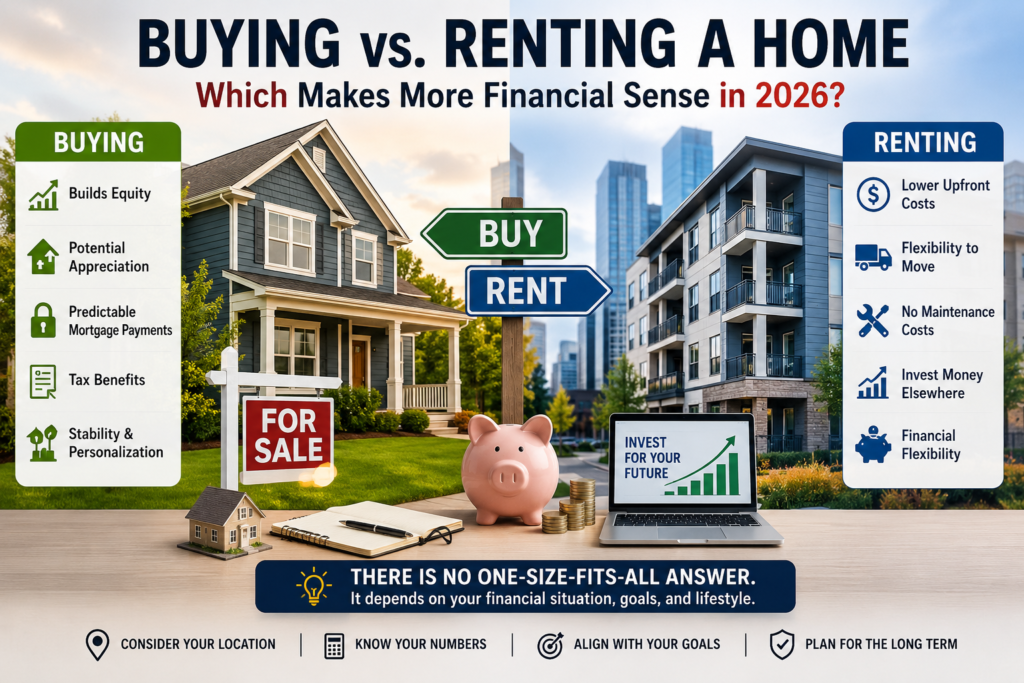
The Big Housing Question Facing Americans in 2026
For generations, buying a home has been viewed as a major milestone in the United States. It’s often tied to financial success, family stability, and the classic American Dream. Many people grow up hearing that owning a home is one of the smartest investments they’ll ever make.
But in 2026, the decision isn’t quite that simple.
Mortgage rates remain higher than the ultra-low levels Americans enjoyed a few years ago. Home prices in many cities are still elevated, and rental costs continue to climb. As a result, millions of Americans are asking a very practical question:
Does it make more financial sense to buy a home or continue renting?
The truth is that there’s no one-size-fits-all answer. What works for one family may be completely wrong for another. Your income, lifestyle, career plans, location, and long-term financial goals all play an important role.
Let’s take a closer look at the numbers, the benefits, the drawbacks, and the real-world factors that can help you make the best decision in today’s housing market.
Understanding the American Housing Market in 2026
Before comparing renting and buying, it’s worth taking a step back and looking at the bigger picture.
Housing affordability remains one of the biggest challenges facing Americans today. While some markets have cooled slightly, many desirable cities and suburbs continue to experience strong demand and limited housing inventory.
Several factors are shaping the market in 2026:
- Mortgage rates remain higher than pre-2022 levels.
- Property taxes continue rising in many states.
- Homeowners insurance premiums have increased significantly.
- Rental demand remains strong in major metropolitan areas.
- Housing shortages persist in many regions.
Because of these conditions, the choice between buying and renting has become less emotional and more financial than ever before.
Why Buying a Home Can Be a Smart Financial Move
Building Equity Instead of Paying Rent
One of the strongest arguments for buying a home is the ability to build equity.
When you make a mortgage payment, a portion of that money goes toward owning more of your property. Over time, your ownership stake grows.
Rent works differently. Once you pay your landlord, that money is gone.
For many American households, home equity represents a substantial portion of their net worth. In fact, building equity has historically been one of the primary ways middle-class families create long-term wealth.
The Potential for Home Appreciation
Real estate markets rise and fall, but over long periods, home values have generally trended upward.
That means a house purchased today could be worth considerably more ten or twenty years from now.
If you buy in a growing neighborhood or a region with strong economic development, you may benefit from:
- Increased property value
- Higher net worth
- Potential profits when selling
Of course, appreciation is never guaranteed. Still, history suggests that real estate has been a powerful wealth-building tool for patient homeowners.
More Predictable Housing Costs
One benefit many buyers overlook is stability.
With a fixed-rate mortgage, your principal and interest payment remains relatively consistent throughout the life of the loan.
Renters, on the other hand, often face annual rent increases. In some markets, those increases can be substantial.
Knowing what your housing payment will look like years into the future can make budgeting much easier.
Possible Tax Advantages
Depending on your financial situation, homeownership may also come with tax benefits.
Some homeowners may qualify for deductions related to:
- Mortgage interest
- Property taxes
- Capital gains exclusions when selling a primary residence
Tax laws change frequently, so it’s always wise to consult a qualified tax professional before making assumptions about savings.
The Costs of Homeownership Many Buyers Forget
Owning a home can be rewarding, but it’s not cheap.
Many first-time buyers focus exclusively on the mortgage payment and underestimate the true cost of ownership.
Maintenance Never Stops
Homes require constant attention.
At some point, you’ll likely face expenses such as:
- Roof repairs
- Plumbing issues
- Heating and cooling system replacements
- Appliance failures
- Landscaping and yard maintenance
Financial planners often recommend setting aside 1% to 3% of a home’s value each year for maintenance.
For a $400,000 home, that’s potentially $4,000 to $12,000 annually.
Property Taxes Add Up
Property taxes vary dramatically depending on where you live.
In some states, they may be relatively manageable. In others, they can add hundreds—or even thousands—of dollars to your annual housing costs.
It’s an expense that buyers should never ignore.
Insurance Costs Are Rising
Homeowners insurance has become increasingly expensive in recent years.
Natural disasters, inflation, and rebuilding costs have pushed premiums higher across many parts of the country.
For some homeowners, insurance now represents a significant monthly expense.
The Opportunity Cost of Your Down Payment
Here’s something many people don’t consider.
The money used for a down payment could potentially be invested elsewhere.
Imagine putting $60,000 into diversified index funds rather than a house down payment. Over time, that investment could generate meaningful returns.
This is why some financial experts argue that renting and investing aggressively may outperform homeownership under certain circumstances.
Why Renting Can Sometimes Be the Better Choice
Renting often gets a bad reputation, but it offers several financial advantages that shouldn’t be overlooked.
Lower Upfront Costs
Buying a home typically requires a significant amount of cash upfront.
You may need to pay for:
- Down payments
- Closing costs
- Home inspections
- Moving expenses
Renting is usually much simpler.
Most renters only need a security deposit, first month’s rent, and moving costs.
For many Americans, that difference can be substantial.
Greater Flexibility
Life changes quickly.
A new job opportunity, family situation, or lifestyle preference can make relocation necessary.
Renting allows you to move far more easily than homeownership.
Selling a house can take months and often comes with realtor commissions, closing fees, and unexpected complications.
Renters generally enjoy much more freedom.
No Surprise Repair Bills
When the water heater breaks or the roof starts leaking, renters typically aren’t responsible for the repair costs.
That’s the landlord’s responsibility.
Avoiding these unexpected expenses can provide valuable peace of mind.
More Opportunities to Invest
Renters often have additional cash available because they aren’t paying for:
- Property taxes
- Home maintenance
- Major repairs
- Large down payments
If that money is invested consistently, it can potentially grow into a substantial portfolio over time.
When Buying Usually Makes More Sense
Buying tends to work best under a few specific conditions.
You Plan to Stay Put
The longer you stay in a home, the more likely you’ll recover the costs associated with purchasing it.
Closing costs, mortgage interest, and realtor commissions can take years to offset.
Many financial experts recommend planning to stay at least five to seven years before buying.
Your Income Is Stable
Homeownership is easier when your finances are predictable.
A stable job, manageable debt, and a healthy emergency fund can help ensure that your home becomes an asset rather than a financial burden.
You Want a Forced Savings Strategy
Let’s face it—not everyone is a disciplined investor.
For some people, a mortgage acts as a built-in savings plan. Each payment gradually increases home equity, helping build wealth over time.
When Renting May Be the Smarter Financial Choice
Renting isn’t just for people who can’t afford to buy.
In many situations, it’s actually the more strategic option.
You May Relocate Soon
If you expect to move within a few years, renting often makes more sense.
The costs of buying and selling a home in a short period can easily outweigh any potential gains.
Home Prices Are Extremely High
In some American cities, monthly mortgage payments are significantly higher than comparable rents.
When that happens, renting and investing the difference may produce stronger financial results.
You Value Flexibility
Some people simply prefer having fewer financial obligations.
Renting provides flexibility, liquidity, and freedom from many of the responsibilities that come with homeownership.
A Simple Formula: The Price-to-Rent Ratio
One tool many financial experts use is the Price-to-Rent Ratio.
The formula is simple:
Home Price ÷ Annual Rent
As a general rule:
- Below 15: Buying may make more sense.
- Between 15 and 20: Either option could work.
- Above 20: Renting often becomes more attractive.
For example:
A home priced at $500,000 with annual rent of $24,000 produces a ratio of approximately 20.8.
In that situation, renting deserves serious consideration.
What Personal Finance Experts Are Saying
Many financial experts agree on one thing: the best housing decision depends on your individual circumstances.
Some continue to view homeownership as one of the most effective paths to long-term wealth.
Others believe disciplined investing in low-cost index funds can generate comparable or even superior results without the responsibilities of owning property.
Ultimately, buying a home is both a financial decision and a lifestyle decision.
Neither option is universally right or wrong.
Books That Can Help You Make a Smarter Decision
If you’re trying to decide whether to buy or rent, these books offer valuable insights.
The Millionaire Next Door by Thomas J. Stanley and William D. Danko
A timeless look at how ordinary Americans build wealth through disciplined financial habits.
The Simple Path to Wealth by J.L. Collins
An excellent guide to investing, financial independence, and long-term wealth creation.
Set for Life by Scott Trench
Offers practical advice on real estate, financial freedom, and building wealth from the ground up.
Rich Dad Poor Dad by Robert Kiyosaki
Introduces foundational concepts about assets, liabilities, and financial education.
The Book on Rental Property Investing by Brandon Turner
A valuable resource for readers interested in real estate investing and passive income.
Final Thoughts: Buy or Rent in 2026?
The debate between buying and renting isn’t really about finding a universally correct answer.
It’s about finding the right answer for you.
Buying may make sense if you’re financially stable, plan to stay in one place for several years, and want to build equity over time.
Renting may be the better choice if you value flexibility, live in an expensive housing market, or prefer investing your money elsewhere.
At the end of the day, financial success doesn’t come from following conventional wisdom. It comes from making intentional decisions that align with your goals, your budget, and your vision for the future.
Whether you choose to buy or rent in 2026, the smartest move is the one that strengthens your overall financial health and moves you closer to financial freedom.
Frequently Asked Questions
1. Is it cheaper to buy or rent a home in 2026?
The answer depends largely on where you live. In some areas, monthly mortgage payments may be similar to rent payments, making buying attractive. In high-cost cities, however, renting may be significantly cheaper when you factor in property taxes, homeowners insurance, maintenance, and closing costs.
Recommended Book:
The Simple Path to Wealth by J.L. Collins
2. How much money should I save before buying a house?
Most financial experts recommend saving enough for a down payment, closing costs, moving expenses, and an emergency fund. Many buyers aim for at least 10% to 20% of the home’s purchase price, although some loan programs allow smaller down payments.
Recommended Book:
Set for Life by Scott Trench
3. Is buying a home still a good investment in 2026?
For many Americans, homeownership remains an effective long-term wealth-building strategy. However, housing markets vary, and buyers should consider local market conditions, mortgage rates, and their expected length of stay before purchasing.
Recommended Book:
The Millionaire Real Estate Investor by Gary Keller
4. What are the hidden costs of owning a home?
Beyond the mortgage payment, homeowners must budget for maintenance, repairs, property taxes, homeowners insurance, utilities, HOA fees, and potential renovations.
Recommended Book:
The Total Money Makeover by Dave Ramsey
5. How long should I plan to stay in a home before buying makes financial sense?
Many financial advisors suggest staying in a home for at least five to seven years. This allows enough time to offset buying and selling costs and potentially benefit from property appreciation.
Recommended Book:
Your Money or Your Life by Vicki Robin and Joe Dominguez
6. Is renting a waste of money?
Not necessarily. Renting provides flexibility, predictable housing costs, and freedom from maintenance expenses. For some people, renting while investing the difference can be a smart financial strategy.
Recommended Book:
The Psychology of Money by Morgan Housel
7. How do mortgage rates affect the buy-versus-rent decision?
Higher mortgage rates increase monthly payments and reduce affordability. When rates rise significantly, renting may become more attractive, especially in expensive housing markets.
Recommended Book:
The Intelligent Investor by Benjamin Graham
8. What is the Price-to-Rent Ratio?
The Price-to-Rent Ratio compares home prices to annual rental costs. It helps buyers evaluate whether purchasing or renting is more economical in a specific market.
Recommended Book:
The Book on Rental Property Investing by Brandon Turner
9. Can renting help me build wealth?
Yes. Renters who consistently invest money that would otherwise go toward homeownership expenses can build substantial wealth through stocks, index funds, retirement accounts, and other investments.
Recommended Book:
The Little Book of Common Sense Investing by John C. Bogle
10. What credit score do I need to buy a house?
While requirements vary by lender, most conventional mortgages prefer a credit score of 620 or higher. Better credit scores often qualify for lower interest rates and better loan terms.
Recommended Book:
Personal Finance For Dummies by Eric Tyson
11. Should first-time homebuyers buy in 2026 or wait?
The decision depends on personal finances, local housing conditions, job stability, and long-term goals. Waiting for perfect market conditions can sometimes mean missing opportunities to build equity.
Recommended Book:
First-Time Home Buyer: The Complete Playbook by Scott Trench
12. What are the advantages of renting over buying?
Renting offers flexibility, lower upfront costs, no repair bills, and easier relocation. It may be ideal for individuals who move frequently or are still building savings.
Recommended Book:
I Will Teach You to Be Rich by Ramit Sethi
13. What are the biggest benefits of homeownership?
Homeownership can provide stability, equity growth, appreciation potential, tax advantages, and a sense of personal control over your living space.
Recommended Book:
The Millionaire Next Door by Thomas J. Stanley and William D. Danko
14. How much should my housing payment be compared to my income?
Many experts recommend spending no more than 28% of gross monthly income on housing expenses and no more than 36% on total debt obligations.
Recommended Book:
The Bogleheads’ Guide to Investing by Taylor Larimore, Mel Lindauer, and Michael LeBoeuf
15. Which is better for financial freedom: buying or renting?
Neither option automatically leads to financial freedom. Success depends on how well you manage your money, invest consistently, avoid excessive debt, and align housing decisions with your long-term goals.
Recommended Book:
Financial Freedom by Grant Sabatier