
By staff | Last Updated: June 2026
7-minute read
Imagine waking up in the morning, checking your phone, and seeing that you made money overnight—even while you were sleeping.
That’s the dream behind passive income, and in 2026, more Americans than ever are trying to make it a reality.
With rising living costs, inflation, job uncertainty, and growing interest in financial freedom, people are no longer relying on a single paycheck alone. Instead, they’re looking for smart ways to build income streams that continue generating money month after month.
But here’s something important most “get-rich-quick” influencers won’t tell you:
Passive income isn’t magic.
The best passive income strategies require patience, consistency, and smart investing. The good news? Once your investments begin working for you, they can continue producing income for years—even decades—with less day-to-day effort.
Whether you’re a complete beginner or someone looking to diversify your investments, this guide will walk you through some of the best passive income investment strategies Americans are using in 2026 to build long-term wealth.
What Is Passive Income?
Passive income is money you earn without actively working for every dollar.
Unlike a traditional 9–5 job where your income depends on the hours you work, passive income comes from assets you own or investments you’ve built over time.
Some of the most common examples include:
- Dividend-paying stocks
- Rental real estate
- REITs (Real Estate Investment Trusts)
- Index funds and ETFs
- Bonds and bond funds
- High-yield savings accounts
- Digital products
- Affiliate marketing websites
Now, let’s be realistic for a second: most passive income streams are not completely passive in the beginning.
You usually need:
- Money to invest
- Time to learn
- Patience to grow your investments
- Discipline to stay consistent
But over time, these investments can begin generating reliable income with far less effort than a
traditional job.
That’s why passive income has become such a major financial goal for Americans in 2026.
1. Dividend Stocks: Getting Paid Just for Owning Shares
Dividend investing remains one of the most popular passive income strategies in America—and for good reason.
When you buy dividend stocks, you’re investing in companies that share part of their profits with shareholders through regular dividend payments.
In simple terms: You own the stock → the company pays you cash regularly.
Some famous American dividend-paying companies include:
- Coca-Cola
- Johnson & Johnson
- PepsiCo
- Procter & Gamble
- McDonald’s
Many of these companies are known as “Dividend Aristocrats” because they’ve consistently increased their dividends for decades.
That kind of reliability is exactly why long-term investors love them.
Why Dividend Investing Works So Well
Americans are drawn to dividend investing because it combines two powerful benefits:
- Ongoing cash flow
- Long-term growth potential
You’re not only earning dividends—you may also benefit if the stock price increases over time.
And when you reinvest your dividends instead of spending them immediately, compounding begins to work in your favor.
That’s where wealth starts building quietly in the background.
Recommended Investing Books
If you want to understand dividend investing deeply, two excellent books are:
The Single Best Investment by Lowell Miller
A fantastic guide to building long-term income through dividend-growth investing.
The Intelligent Investor by Benjamin Graham
This timeless classic influenced Warren Buffett and continues to teach investors how to think rationally about long-term wealth.
These books remain highly recommended among serious investors because they focus on discipline, patience, and sustainable investing—not hype.
2. Index Funds and ETFs: The Easiest Way to Invest
If picking individual stocks sounds stressful, index funds and ETFs may be the perfect solution.
In fact, many financial experts believe index investing is one of the smartest strategies for the average American investor.
Why?
Because instead of trying to guess which company will succeed, index funds allow you to invest in hundreds—or even thousands—of companies at once.
For example:
- S&P 500 index funds invest in America’s 500 largest companies.
- Total market funds spread your money across nearly the entire U.S. stock market.
That means instant diversification with very little effort.
Why Americans Love Index Funds
Index funds are popular because they’re:
- Simple
- Low-cost
- Beginner-friendly
- Diversified
- Low maintenance
This is often called the “set-it-and-forget-it” investment strategy.
You invest consistently, leave your emotions out of it, and allow time and compounding to do the heavy lifting.
Best Book for Beginners
The Little Book of Common Sense Investing by John C. Bogle
This book explains why low-cost index funds consistently outperform most active investors over the long run.
It’s one of the best books for beginners who want a simple path to financial growth without spending hours analyzing stocks.
3. REITs: Real Estate Investing Without Becoming a Landlord
Real estate has created enormous wealth for Americans over the years.
But let’s face it: Not everyone wants to deal with tenants calling at midnight because the sink is leaking.
That’s why REITs have become so popular.
A REIT (Real Estate Investment Trust) allows you to invest in real estate without directly owning property yourself.
REITs typically invest in:
- Apartment complexes
- Shopping centers
- Hospitals
- Warehouses
- Office buildings
- Data centers
Many REITs pay attractive dividends, making them ideal for passive income seekers.
Why REITs Are So Appealing
REITs offer:
- Regular dividend income
- Real estate exposure
- Lower startup capital
- No property management headaches
For many Americans, REITs provide the benefits of real estate investing without the stress of becoming a landlord.
Recommended Real Estate Book
Rich Dad Poor Dad by Robert Kiyosaki
Love it or criticize it, this book changed how millions of Americans think about money, assets, and financial freedom.
Its core lesson is simple: Buy assets that put money into your pocket.
That mindset alone has inspired countless investors to begin building passive income streams.
4. Bonds: The More Stable Side of Investing
Bonds rarely get as much attention as stocks, but they still play an important role in passive income investing.
When you buy a bond, you’re essentially lending money to a government or company in exchange for interest payments.
Think of bonds as the “steady and predictable” part of a portfolio.
Common Bonds Americans Invest In
- U.S. Treasury bonds
- Municipal bonds
- Corporate bonds
- Bond ETFs
In 2026, higher interest rates have made bonds more attractive again, especially for investors focused on income and stability.
Why Bonds Still Matter
Bonds can help:
- Reduce portfolio volatility
- Generate predictable income
- Protect wealth during market downturns
- Balance risk in retirement portfolios
They may not produce explosive growth, but they can add stability and peace of mind.
5. High-Yield Savings Accounts and CDs
Sometimes the safest passive income strategy is also the simplest.
High-yield savings accounts and Certificates of Deposit (CDs) won’t make you rich overnight, but they can help your money grow safely while remaining accessible.
Compared to traditional savings accounts, online banks often offer much higher interest rates.
Why Americans Use Them
These accounts are popular because they’re:
- FDIC-insured
- Extremely low risk
- Easy to open
- Great for emergency funds
They’re especially useful for:
- Beginners
- Conservative investors
- Short-term savings goals
If you’re not ready for the stock market yet, this can be a comfortable starting point.
6. Rental Real Estate: A Long-Term Wealth Builder
Rental properties remain one of the most powerful wealth-building tools in America.
A good rental property can generate:
- Monthly cash flow
- Tax benefits
- Property appreciation
- Long-term equity growth
But it’s important to understand something:
Rental real estate is not always truly passive.
Managing tenants, maintenance, repairs, and vacancies can become time-consuming unless you hire property managers.
Still, many Americans continue investing in rental properties because of the long-term wealth potential.
Popular U.S. markets for rental investing often include:
- Texas
- Florida
- Tennessee
- Arizona
- North Carolina
These states continue attracting investors due to population growth and strong rental demand.
7. Why Multiple Income Streams Matter
One of the smartest things you can do financially is avoid depending on a single source of income.
That’s why many wealthy Americans build multiple passive income streams over time.
They often combine:
- Dividend stocks
- ETFs
- REITs
- Bonds
- Rental properties
- Digital products
- Affiliate marketing businesses
Diversification helps reduce risk while creating more consistent income.
If one investment underperforms temporarily, other income streams can continue supporting
your financial goals.
Common Passive Income Mistakes to Avoid
1.Chasing Unrealistic Returns
If an investment sounds too good to be true, it probably is.
Extremely high dividend yields or “guaranteed” returns can sometimes signal risky or unstable investments.
2.Expecting Instant Wealth
Passive income takes time.
Compounding works slowly at first—but becomes incredibly powerful over the long run.
3.Ignoring Taxes
Taxes matter.
Americans should understand:
- Dividend taxes
- Capital gains taxes
- Real estate tax rules
A good tax strategy can help you keep more of your investment income.
4.Not Reinvesting Earnings
Reinvesting dividends and profits is one of the fastest ways to accelerate wealth building.
Small amounts invested consistently can grow surprisingly large over time.
The Best Passive Income Strategy for Beginners
If you’re just starting out, keep things simple.
A beginner-friendly approach might look like this:
- Build an emergency fund
- Invest consistently into index funds
- Add dividend ETFs gradually
- Diversify with REITs and bonds
- Reinvest your earnings automatically
You don’t need to be rich to start investing.
What matters most is consistency.
Final Thoughts
Passive income investing is not about becoming rich overnight.
It’s about building assets today that can continue paying you tomorrow.
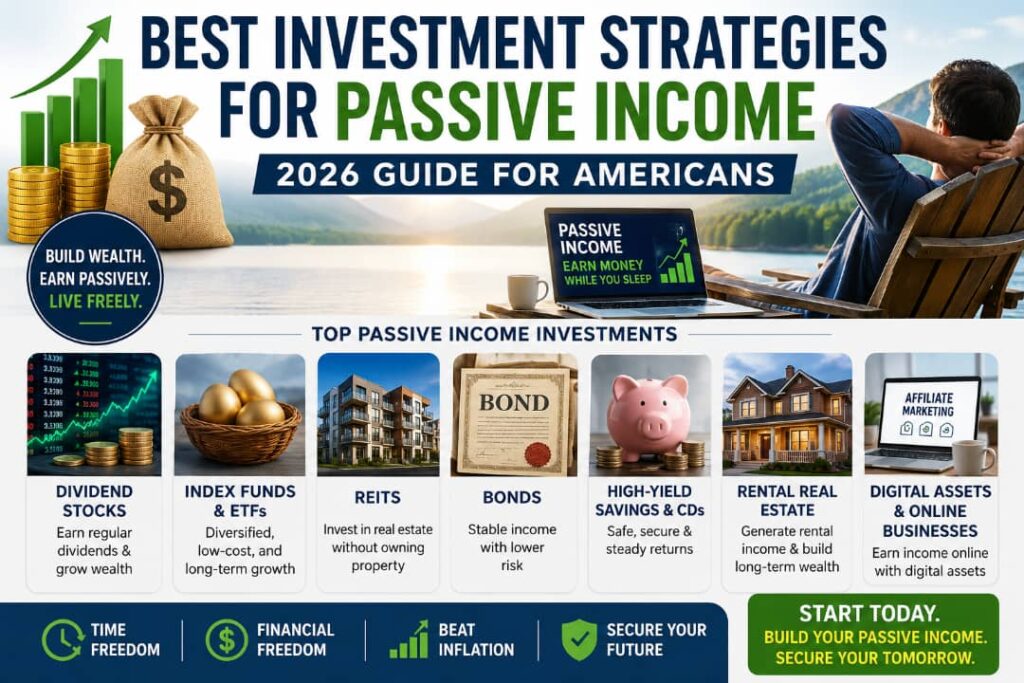
The best passive income strategies for Americans in 2026 include:
- Dividend stocks
- Index funds
- ETFs
- REITs
- Bonds
- Rental real estate
- High-yield savings accounts
The earlier you start, the more time compounding has to work in your favor.
Even small investments made consistently can eventually grow into meaningful income streams that improve your financial freedom and quality of life.
And perhaps the most important investment of all?
Your financial education.
Books like The Intelligent Investor, The Little Book of Common Sense Investing, and Rich Dad Poor Dad continue helping millions of Americans learn how money really works—and how to make it work for them instead.
Frequently Asked Questions
1. What is the best passive income investment for beginners in 2026?
For most beginners in America, index funds and dividend ETFs are often considered the best starting point for passive income investing. They’re simple, diversified, low-cost, and require very little maintenance.
Many new investors start with S&P 500 index funds because they provide exposure to hundreds of major U.S. companies in one investment. Over time, dividend-paying ETFs can help generate steady income while your portfolio continues growing.
If you’re just getting started, investing books like The Little Book of Common Sense Investing by John C. Bogle can help you understand how long-term investing really works.
2. Can you really make money while you sleep through passive income investing?
Yes—but it doesn’t happen overnight.
Passive income investing allows your money to work for you through dividends, interest payments, rental income, or investment growth. Once your investments are set up properly, they can continue generating income with less day-to-day effort.
However, most successful passive income strategies require:
- Consistent investing
- Patience
- Long-term thinking
- Reinvesting profits
The earlier you start investing, the more powerful compounding becomes.
3. How much money do I need to start investing for passive income?
One of the biggest myths about investing is that you need thousands of dollars to begin.
In 2026, many Americans start investing with as little as $10 to $100 using investing apps, brokerage accounts, and fractional shares.
You can begin small by:
- Buying index funds
- Investing in dividend ETFs
- Opening a high-yield savings account
- Using automatic monthly investing
Consistency matters far more than starting with a huge amount of money.
4. Are dividend stocks good for passive income?
Yes—dividend stocks remain one of the most popular passive income investments in America.
Dividend-paying companies distribute part of their profits to shareholders regularly, usually every quarter. Many investors use dividends to create ongoing cash flow or reinvest them for faster portfolio growth.
Popular dividend-paying companies often include:
- Coca-Cola
- PepsiCo
- Johnson & Johnson
- McDonald’s
- Procter & Gamble
Many long-term investors prefer dividend-growth companies because they tend to increase payouts over time.
5. What are the safest passive income investments?
While no investment is completely risk-free, some passive income investments are generally considered safer than others.
Safer options often include:
- High-yield savings accounts
- Certificates of Deposit (CDs)
- U.S. Treasury bonds
- Bond ETFs
- Broad index funds
These investments usually offer lower returns than aggressive stocks, but they may provide greater stability and lower risk.
For conservative investors, balancing safety and growth is extremely important.
6. What is the difference between active income and passive income?
Active income is money you earn by directly working for it, such as:
- Salaries
- Hourly wages
- Freelance work
Passive income, on the other hand, comes from investments or assets that continue generating income over time.
Examples include:
- Dividend payments
- Rental property income
- Interest from savings accounts
- Royalties
- Affiliate marketing websites
Many Americans aim to build passive income streams so they’re less dependent on a single paycheck.
7. Are REITs a good passive income investment in 2026?
Yes—REITs (Real Estate Investment Trusts) continue to be popular among passive income investors.
REITs allow you to invest in real estate without directly owning or managing property yourself. Many REITs pay regular dividends, making them attractive for income-focused investors.
REITs often invest in:
- Apartment buildings
- Hospitals
- Warehouses
- Data centers
- Shopping centers
For Americans who want real estate exposure without becoming landlords, REITs can be an excellent option.
8. Is rental property truly passive income?
Rental real estate can generate excellent long-term income, but it’s not always completely passive.
Property owners may still deal with:
- Repairs
- Tenants
- Vacancies
- Property management
- Maintenance costs
Some investors hire property managers to reduce the workload, but that also reduces profits.
Even so, rental real estate remains one of the most effective wealth-building strategies in America.
9. Should I invest in index funds or individual stocks?
For most beginners, index funds are usually the safer and simpler choice.
Index funds provide:
- Instant diversification
- Lower risk
- Lower fees
- Less stress
- Long-term growth potential
Individual stocks can sometimes produce higher returns, but they also come with greater risk.
That’s why many financial experts recommend starting with index funds before trying to pick individual stocks.
10. How long does it take to build meaningful passive income?
Passive income investing is a long-term strategy.
Some people begin seeing small monthly earnings within the first year, but meaningful passive income often takes several years of consistent investing and reinvesting.
The key is staying patient and avoiding emotional decisions during market ups and downs.
Many successful investors focus on:
- Monthly investing
- Reinvesting dividends
- Long-term compounding
- Diversification
Building wealth slowly is usually more sustainable than chasing quick profits.
11. What are the biggest passive income investing mistakes beginners make?
Some of the most common mistakes include:
- Chasing “get-rich-quick” investments
- Investing money they may need soon
- Ignoring diversification
- Panic-selling during market downturns
- Failing to reinvest profits
- Expecting instant results
Successful investing is usually boring, consistent, and long-term.
That’s why financial education matters so much.
12. What books should beginners read about passive income investing?
Some of the most recommended investing books for Americans include:
The Intelligent Investor — Benjamin Graham
A timeless classic about long-term value investing.
The Little Book of Common Sense Investing — John C. Bogle
Perfect for understanding index funds and low-cost investing.
Rich Dad Poor Dad — Robert Kiyosaki
Focuses on building assets and financial independence.
The Single Best Investment — Lowell Miller
Excellent for learning dividend-growth investing.
These books can help beginners build smarter investing habits and avoid costly financial mistakes.
13. Is passive income taxable in the United States?
Yes. Most passive income investments are taxable in the U.S.
Taxes may apply to:
- Dividends
- Capital gains
- Rental income
- Interest income
However, some accounts—like Roth IRAs and 401(k)s—may offer tax advantages for long-term investors.
Many Americans work with financial advisors or tax professionals to create tax-efficient investing strategies.
14. Can passive income help with early retirement?
Absolutely.
Many Americans pursuing financial independence and early retirement focus heavily on building passive income streams.
The goal is to create investments that generate enough income to cover living expenses without depending entirely on employment.
Common early retirement strategies include:
- Dividend investing
- Index fund investing
- Rental real estate
- REITs
- Digital businesses
The more passive income you build, the more financial flexibility you may eventually have.
15. What is the smartest passive income strategy in 2026?
For many Americans, the smartest strategy is usually a diversified one.
Instead of relying on a single investment, experienced investors often combine:
- Index funds
- Dividend ETFs
- REITs
- Bonds
- Savings accounts
- Real estate
- Online income streams
Diversification helps reduce risk while creating more stable long-term income.
The most important thing is not finding the “perfect” investment—it’s starting early, staying consistent, and continuing to learn.
Disclosure: This article is for informational and educational purposes only and should not be construed as personalized financial advice. Always consult a licensed financial advisor before making investment decisions. This article contains affiliate links.We only recommend books we genuinely believe in.