
By staff | Last Updated: June 2026
6-minute read
Why Building Wealth Matters More Than Ever
Let’s face it, earning a good income doesn’t automatically guarantee financial security anymore.
Across America, millions of people work hard, pay their bills, and do everything they’re supposed to do financially. Yet many still worry about retirement, rising healthcare costs, inflation, and whether they’ll have enough money to live comfortably in the future.
The reality is that building wealth has become less of a luxury and more of a necessity.
The encouraging news? You don’t need to be a Wall Street expert, inherit a fortune, or earn a seven-figure salary to become wealthy. In fact, many financially successful Americans started with ordinary jobs, modest incomes, and a commitment to making smart financial decisions over time.
Whether you’re fresh out of college, raising a family, or getting serious about retirement planning, the fundamentals of wealth creation remain surprisingly simple: earn wisely, spend intentionally, save consistently, and invest for the long term.
The journey isn’t always quick, but it is achievable.
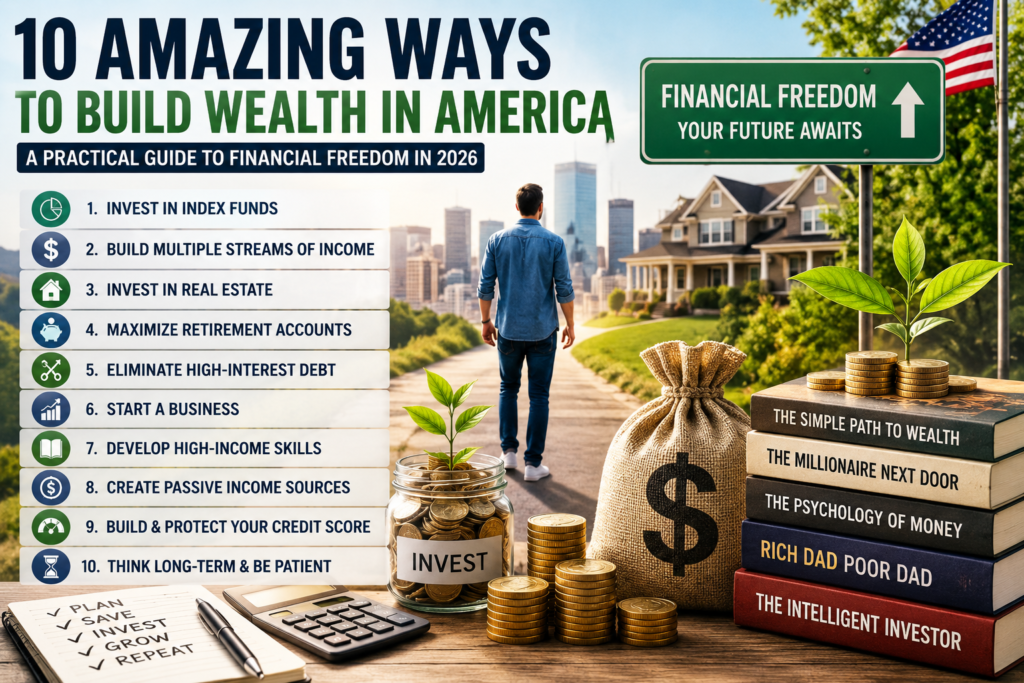
Let’s explore ten proven ways Americans are building wealth and creating lasting financial freedom in 2026.
1. Invest Consistently in Index Funds
If you were to ask many self-made millionaires how they built their wealth, you’d hear one strategy mentioned again and again: consistent investing.
More specifically, investing in low-cost index funds.
Instead of trying to predict which company will become the next big winner, index funds allow you to own a small piece of hundreds, or even thousands of companies at once. You’re essentially betting on the long-term growth of the American economy rather than gambling on individual stocks.
That’s a much less stressful approach.
Some of the biggest advantages include:
- Low investment fees
- Instant diversification
- Long-term market growth
- Minimal day-to-day management
Perhaps the best part is that you don’t need to be an investing expert to get started. Many successful investors simply invest a fixed amount every month and allow compound growth to do the heavy lifting.
Recommended Book
“The Simple Path to Wealth” by J.L. Collins
This highly recommended personal finance classic breaks down investing in a way that’s easy to understand, even for complete beginners. Collins explains why simple index fund investing has helped countless people achieve financial independence.
2. Build Multiple Streams of Income
Relying on a single paycheck can feel risky in today’s economy.
Layoffs happen. Industries change. Unexpected expenses appear when you least expect them.
That’s why many wealthy Americans focus on creating multiple streams of income.
Think of it as building several financial engines instead of depending on just one.
Additional income sources might include:
- Freelance work
- Dividend-paying investments
- Rental properties
- Online businesses
- Digital products
- Consulting services
- Royalties from creative work
At first, these side income streams may seem small. However, over time they can grow into significant sources of cash flow and financial stability.
Many people discover that a side hustle started in the evenings eventually becomes a meaningful contributor to their wealth-building journey.
Recommended Book
“Multiple Streams of Income” by Robert G. Allen
This classic guide offers practical strategies for creating additional income sources and reducing dependence on a traditional paycheck.
3. Invest in Real Estate
For generations, real estate has been one of America’s favorite wealth-building tools, and for good reason.
Unlike many investments, real estate has the potential to generate income while simultaneously increasing in value.
Property owners can benefit from:
- Appreciation over time
- Monthly rental income
- Valuable tax advantages
- Protection against inflation
- Leverage through financing
Many self-made millionaires credit real estate as a major contributor to their financial success.
That doesn’t mean you need to own dozens of apartment buildings. Even a single rental property can become a powerful wealth-building asset when managed properly.
The key is approaching real estate as a long-term investment rather than a quick profit opportunity.
Recommended Book
“The Book on Rental Property Investing” by Brandon Turner
A practical, beginner-friendly guide that explains how rental properties can help build lasting wealth.
4. Maximize Your Retirement Accounts
One of the smartest wealth-building opportunities available to Americans is hiding in plain sight: retirement accounts.
Unfortunately, many people don’t take full advantage of them.
Accounts such as:
- 401(k)s
- Roth IRAs
- Traditional IRAs
- SEP IRAs
- Solo 401(k)s
offer significant tax benefits that can help your money grow faster over time.
Imagine investing consistently for 20, 30, or even 40 years while receiving tax advantages along the way. That’s where the real power of compound growth begins to shine.
Even relatively small contributions made consistently can turn into substantial retirement savings.
Recommended Book
“The Bogleheads’ Guide to Retirement Planning” by Taylor Larimore
A straightforward resource packed with practical advice for Americans who want to build a secure financial future.
5. Eliminate High-Interest Debt
Building wealth becomes much harder when high-interest debt is constantly draining your finances.
Think about it this way: if you’re paying 20% interest on a credit card balance, that debt is working harder against you than many investments can work for you.
Common wealth-killers include:
- Credit card debt
- Payday loans
- Personal loans with high interest rates
Paying off these obligations can feel like giving yourself an immediate financial raise.
The less money you’re sending to lenders every month, the more money you can direct toward investments, savings, and income-producing assets.
Recommended Book
“The Total Money Makeover” by Dave Ramsey
A popular step-by-step guide focused on debt elimination, budgeting, and long-term financial success.
6. Start a Business
America remains one of the best countries in the world for entrepreneurship.
Business ownership offers:
- Unlimited income potential
- Tax advantages
- Asset creation
- Scalability
- Equity growth
Many of today’s wealthiest Americans accumulated their fortunes through business ownership rather than traditional employment.
Popular opportunities include:
- E-commerce
- Consulting
- Software development
- Content creation
- Digital marketing
- Service businesses
Recommended Book
“The Millionaire Fastlane” by M.J. DeMarco
A thought-provoking book that challenges conventional wealth-building approaches and highlights entrepreneurship.
7. Develop High-Income Skills
One of the best investments you can make is investing in yourself.
High-income skills often include:
- Software development
- Artificial intelligence
- Sales
- Marketing
- Copywriting
- Data analytics
- Financial consulting
Increasing your earning power creates more money available for saving and investing.
In today’s economy, specialized skills can significantly increase your lifetime income.
Recommended Book
“So Good They Can’t Ignore You” by Cal Newport
This book explains how developing valuable skills can lead to exceptional career opportunities and financial success.
8. Create Passive Income Sources
Passive income is money earned with minimal ongoing effort.
Popular passive income ideas include:
- Dividend stocks
- Real estate rentals
- Affiliate marketing
- Digital courses
- YouTube content
- E-books
- Licensing agreements
While passive income usually requires upfront work, it can eventually generate cash flow even when you’re not actively working.
Recommended Book
“Passive Income, Aggressive Retirement” by Rachel Richards
A practical guide to creating passive income and achieving financial independence.
9. Build and Protect Your Credit Score
A strong credit score can save Americans thousands of dollars over their lifetime.
Benefits include:
- Lower mortgage rates
- Better loan terms
- Easier business financing
- Lower insurance costs
Good credit enables access to opportunities that can accelerate wealth creation.
Simple ways to improve credit include:
- Paying bills on time
- Maintaining low credit utilization
- Avoiding unnecessary debt
- Monitoring credit reports regularly
Recommended Book
“Your Score” by Anthony Davenport
An informative guide to understanding and improving your credit score.
10. Think Long-Term and Practice Patience
The most overlooked wealth-building strategy is patience.
Most wealthy individuals did not become rich overnight.
They:
- Invested consistently
- Avoided emotional decisions
- Stayed focused on long-term goals
- Reinvested profits
- Allowed compound growth to work
Wealth is often built gradually through disciplined habits repeated over many years.
The greatest financial advantage available to most Americans is time.
Recommended Book
“The Psychology of Money” by Morgan Housel
One of the most influential personal finance books of recent years, focusing on the behavioral side of wealth creation.
Common Wealth-Building Mistakes to Avoid
As you begin your journey, avoid these common mistakes:
- Trying to get rich quickly
- Ignoring retirement savings
- Carrying excessive debt
- Failing to diversify investments
- Not maintaining an emergency fund
- Spending more as income rises
- Chasing investment trends
Avoiding these pitfalls can dramatically improve your financial outcomes.
The Power of Combining Multiple Wealth-Building Strategies
The wealthiest Americans rarely rely on a single strategy.
Instead, they combine several approaches:
- Investing in index funds
- Owning real estate
- Running businesses
- Developing high-income skills
- Creating passive income streams
- Utilizing tax-advantaged accounts
The combination creates a powerful wealth-building system capable of generating long-term financial security and generational wealth.
Final Thoughts
Building wealth in America doesn’t require extraordinary intelligence, a six-figure salary, or lucky breaks. It requires a proven plan, consistent action, and patience.
Start small if necessary. Invest regularly. Eliminate bad debt. Increase your income. Build assets that generate cash flow.
The earlier you begin, the more powerful compound growth becomes.
Remember: wealth is not built by what you earn alone, it’s built by what you keep, invest, and allow to grow over time.
The journey to financial freedom starts with a single step. Take that step today, and your future self will thank you.
?? Frequently Asked Questions
1. What is the fastest way to build wealth in America?
While there’s no guaranteed shortcut to becoming wealthy, the fastest path typically combines increasing your income, investing consistently, eliminating high-interest debt, and owning appreciating assets such as stocks and real estate. Building wealth usually requires discipline and a long-term strategy rather than chasing quick-money schemes.
Recommended Books
- “The Millionaire Fastlane” by M.J. DeMarco
- “The Psychology of Money” by Morgan Housel
2. How much money should I invest each month to build wealth?
The amount depends on your income and financial goals. Many experts recommend investing at least 15% to 20% of your income. Even small monthly investments can grow significantly over time thanks to compound interest.
Recommended Books
- “The Simple Path to Wealth” by J.L. Collins
- “The Little Book of Common Sense Investing” by John C. Bogle
3. Are index funds the best investment for beginners?
For many beginners, index funds are considered one of the safest and simplest investment options. They offer diversification, low fees, and exposure to the broader stock market without requiring extensive investing knowledge.
Recommended Books
- “The Simple Path to Wealth” by J.L. Collins
- “The Bogleheads’ Guide to Investing” by Taylor Larimore
4. Is real estate still a good way to build wealth in 2026?
Yes. Real estate remains one of the most popular wealth-building strategies in America. Rental income, property appreciation, tax advantages, and leverage can all contribute to long-term financial growth.
Recommended Books
- “The Book on Rental Property Investing” by Brandon Turner
- “The Millionaire Real Estate Investor” by Gary Keller
5. What are multiple streams of income?
Multiple streams of income refer to earning money from several different sources instead of relying solely on one job. Examples include side businesses, dividends, rental properties, freelance work, affiliate marketing, and digital products.
Recommended Books
- “Multiple Streams of Income” by Robert G. Allen
- “Rich Dad Poor Dad” by Robert Kiyosaki
6. How can I create passive income?
Passive income can be generated through investments, rental properties, dividend stocks, affiliate marketing websites, online courses, eBooks, and other assets that continue producing income after the initial work is completed.
Recommended Books
- “Passive Income, Aggressive Retirement” by Rachel Richards
- “Rich Dad’s Cashflow Quadrant” by Robert Kiyosaki
7. Should I pay off debt before investing?
In many cases, paying off high-interest debt first is a smart financial move. However, if your employer offers a 401(k) match, it may make sense to contribute enough to receive the full match while simultaneously paying down debt.
Recommended Books
- “The Total Money Makeover” by Dave Ramsey
- “I Will Teach You to Be Rich” by Ramit Sethi
8. What are the best retirement accounts for building wealth?
Popular retirement accounts include:
- 401(k)
- Roth IRA
- Traditional IRA
- SEP IRA
- Solo 401(k)
These accounts offer tax advantages that can significantly increase long-term investment growth.
Recommended Books
- “The Bogleheads’ Guide to Retirement Planning” by Taylor Larimore
- “How to Make Your Money Last” by Jane Bryant Quinn
9. How important is a credit score when building wealth?
A strong credit score can save thousands of dollars through lower interest rates on mortgages, car loans, and business financing. Good credit also provides access to more financial opportunities.
Recommended Books
- “Your Score” by Anthony Davenport
- “Credit Repair Kit for Dummies” by Steve Bucci
10. Can I build wealth on an average income?
Absolutely. Many self-made millionaires earned average incomes but consistently saved, invested, avoided excessive debt, and allowed compound growth to work over time.
Recommended Books
- “The Millionaire Next Door” by Thomas J. Stanley
- “Everyday Millionaires” by Chris Hogan
11. What is the biggest mistake people make when trying to build wealth?
One of the biggest mistakes is trying to get rich quickly. Chasing speculative investments, taking on unnecessary debt, or neglecting long-term planning often leads to financial setbacks.
Recommended Books
- “The Psychology of Money” by Morgan Housel
- “The Intelligent Investor” by Benjamin Graham
12. How does compound interest help build wealth?
Compound interest allows your money to earn returns on both your original investment and previous earnings. Over long periods, this can dramatically increase wealth.
Recommended Books
- “The Richest Man in Babylon” by George S. Clason
- “The Simple Path to Wealth” by J.L. Collins
13. How can I teach my children about wealth building?
Teaching children about saving, investing, budgeting, and entrepreneurship at an early age can help them develop strong financial habits that last a lifetime.
Recommended Books
- “Rich Dad Poor Dad for Teens” by Robert Kiyosaki
- “Smart Money Smart Kids” by Dave Ramsey and Rachel Cruze
14. What role does financial education play in building wealth?
Financial education helps people make informed decisions about investing, debt management, taxes, retirement planning, and wealth preservation. The more you learn, the better equipped you’ll be to grow and protect your money.
Recommended Books
- “The Intelligent Investor” by Benjamin Graham
- “Think and Grow Rich” by Napoleon Hill
15. What is the best book for learning how to build wealth?
There isn’t one perfect book for everyone, but several consistently rank among the best:
- “The Psychology of Money” by Morgan Housel
- “The Simple Path to Wealth” by J.L. Collins
- “Rich Dad Poor Dad” by Robert Kiyosaki
- “The Millionaire Next Door” by Thomas J. Stanley
- “The Intelligent Investor” by Benjamin Graham
These books cover mindset, investing, financial independence, and long-term wealth-building principles.
Disclosure: This article is for informational and educational purposes only and should not be construed as personalized financial advice. Always consult a licensed financial advisor before making investment decisions. This article contains affiliate links.We only recommend books we genuinely believe in.