
By staff | Last Updated: June 2026
6-minute read
If you’ve ever looked at investing and felt like everyone is speaking a different language—stocks, ETFs, diversification, asset allocation, you’re definitely not alone.
Most Americans want to invest. The problem isn’t interest. It’s confusion.
The truth is, building an investment portfolio is much simpler than it looks. You don’t need to predict the next big stock or follow financial news all day. In fact, most long-term investors succeed by doing something surprisingly boring: staying consistent, keeping costs low, and not overthinking it.
This guide will walk you through how to build a simple investment portfolio step-by-step in a way that actually feels doable—even if you’re just getting started.
We’ll also draw lessons from well-known investing books like The Intelligent Investor, The Bogleheads’ Guide to Investing, and A Random Walk Down Wall Street, but in a practical, easy-to-follow way.
What a Simple Investment Portfolio Really Means
Let’s clear something up first.
A simple investment portfolio is not about owning dozens of stocks or constantly trading. It’s the opposite.
Think of it like this:
Instead of trying to pick “winners,” you own a small group of investments that represent the whole market. Over time, those investments grow with the economy.
A simple portfolio usually includes:
- U.S. stocks (companies like Apple or Microsoft, but through index funds)
- International stocks (so you’re not relying only on the U.S. market)
- Bonds (to add stability)
- Index funds or ETFs (the easiest way to invest in everything above)
The main idea, highlighted in The Bogleheads’ Guide to Investing, is this:
👉 “Don’t try to beat the market—be the market.”
Step 1: Get Clear on Why You’re Investing
Before you invest even a dollar, pause and ask yourself a simple question:
Why am I doing this?
Most people invest for reasons like:
- Retirement security
- Buying a home
- Financial independence
- Building long-term wealth
- Paying for education or family goals
Your answer matters because it shapes your entire strategy.
For example:
- If you’re 25 and investing for retirement, you can afford more growth and risk.
- If you’re closer to retirement, protecting your money becomes more important.
This idea is strongly emphasized in The Intelligent Investor by Benjamin Graham: investing is personal. Your portfolio should match your life—not someone else’s strategy on social media.
Step 2: Understand the Building Blocks (Without Overcomplicating It)
You only need to understand three main investment types.
1. Stocks
Stocks represent ownership in companies.
They:
- Can grow your money faster over time
- Come with ups and downs (sometimes big ones)
But here’s the key: most beginners don’t buy individual stocks. Basically, instead, they invest in funds that hold hundreds or thousands of stocks at once.
2. Bonds
Bonds are more like lending money to governments or companies.
They:
- Grow slower
- Are more stable
- Help balance your portfolio when stocks fall
Think of bonds as the “calm” part of your investments.
3. Index Funds and ETFs
This is where everything gets easier.
Index funds and ETFs let you buy the entire market in one purchase.
So instead of picking individual companies, you can invest in:
- The S&P 500 (top 500 U.S. companies)
- Total U.S. stock market
- International markets
John Bogle, founder of Vanguard, spent his life teaching one idea in The Little Book of Common Sense Investing:
👉 Keep investing low-cost, broad, and simple.
Step 3: Choose a Simple Portfolio You Can Stick With
Now let’s make it practical.
You don’t need dozens of strategies. You only need one you can stick with for years.
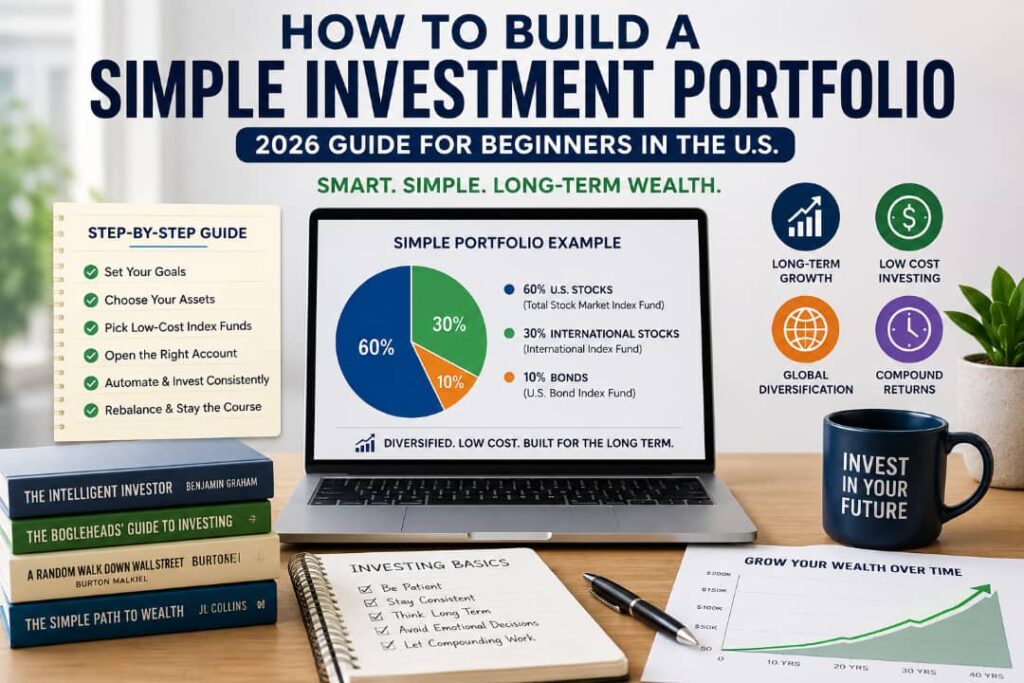
Option 1: The 3-Fund Portfolio (Most Balanced)
This is one of the most recommended strategies in the U.S.
- 60% U.S. As it turns out, stock market
- 30% international stocks
- 10% bonds
Why it works:
- You’re not relying only on one country
- You’re not overexposed to risk
- It’s simple to maintain
This approach is widely supported in The Bogleheads’ Guide to Investing because it removes guesswork.
Option 2: The S&P 500 Portfolio (Very Simple)
- 100% S&P 500 index fund
This is the “keep it extremely simple” approach.
It works well because:
- You invest in America’s biggest companies
- It has strong long-term historical growth
- It requires almost no maintenance
This idea is supported in A Random Walk Down Wall Street by Burton Malkiel, which shows that most active investors fail to beat the S&P 500 over time.
Option 3: Age-Based Strategy (More Flexible)
A simple rule some Americans use:
- Bonds = your age
- Stocks = 100 minus your age
So if you’re 30:
- 30% bonds
- 70% stocks
This helps automatically reduce risk as you get older.
Step 4: Choose Low-Cost Funds (This Matters More Than You Think)
Many beginners lose money not because they invest poorly—but because they pay too much in fees.
Instead, focus on low-cost ETFs like:
- Vanguard Total Stock Market ETF (VOO / VTI)
- Schwab U.S. Broad Market ETF (SCHB)
- iShares Core International ETF (IXUS)
Why fees matter: Even a small fee difference can cost you thousands of dollars over decades.
John Bogle made this point repeatedly:
👉 “Costs matter more than performance.”
Step 5: Open the Right Account for Your Goals
In the U.S., you typically invest through:
401(k)
- Through your employer
- Often includes “free money” (employer match)
IRA (Individual Retirement Account)
- Roth IRA: tax-free growth (very popular for beginners)
- Traditional IRA: tax-deferred
Brokerage Account
- Flexible
- No tax advantages
- Good for general investing
Many beginner investors prefer a Roth IRA because it’s simple and powerful long-term, a strategy often mentioned in The Simple Path to Wealth by JL Collins.
Step 6: Make Investing Automatic (So You Don’t Overthink It)
One of the biggest secrets in investing is this:
👉 The less you try to “manage” your investments, the better you often do.
Set up:
- Automatic monthly contributions
- Automatic ETF purchases
- Dividend reinvestment
Why this works: Because most people don’t fail at investing—they fail at consistency.
Even Warren Buffett has repeatedly emphasized staying invested long-term instead of trying to time the market.
Step 7: Rebalance Without Stress
Over time, your portfolio will naturally shift.
For example:
- Stocks may grow faster than bonds
- Your original plan gets out of balance
Rebalancing simply means:
- Selling a little of what grew too much
- Buying what is now underweighted
You only need to do this once or twice a year. Not weekly. Not monthly.
Step 8: Avoid the Mistakes That Hurt Beginners Most
Most investing mistakes are emotional, not technical.
Here are the big ones:
Chasing “Hot” Stocks
If everyone is talking about it, it’s usually too late.
Panic Selling
Markets go down. That’s normal. Selling during fear locks in losses.
Overcomplicating Everything
More funds don’t mean better results—just more confusion.
Ignoring Fees
Small fees become big problems over time.
As The Intelligent Investor teaches: discipline matters more than excitement.
Step 9: Think in Decades, Not Days
This is where real wealth is built.
Investing is not about quick wins. It’s about time.
Most successful investors:
- Stay invested for 20–40 years
- Ignore short-term news
- Let compound growth do the heavy lifting
Albert Einstein reportedly called compound interest the “eighth wonder of the world.” Whether or not he said it exactly that way, the idea is true: time multiplies money.
Recommended Books (If You Want to Go Deeper)
If you want to build real investing confidence, these books are worth your time:
- The Intelligent Investor — Benjamin Graham
- The Bogleheads’ Guide to Investing — Taylor Larimore
- A Random Walk Down Wall Street — Burton Malkiel
- The Little Book of Common Sense Investing — John Bogle
- The Simple Path to Wealth — JL Collins
- Rich Dad Poor Dad — Robert Kiyosaki
Each one reinforces a simple idea:
👉 You don’t need complexity to build wealth—just consistency.
Final Thoughts
Building a simple investment portfolio isn’t about being perfect. It’s about being consistent.
You don’t need:
- Fancy trading strategies
- Daily market predictions
- Complicated financial tools
What you do need is:
- A simple plan
- Low-cost investments
- Patience
- Time in the market
If you stick with something as simple as a 3-fund portfolio or S&P 500 index investing, you’re already doing better than most people who overthink investing but never actually start.
Wealth building isn’t a secret. It’s just simple habits repeated for a long time.
Frequently Asked Questions
1. What is a simple investment portfolio?
A simple investment portfolio is a collection of easy-to-manage investments designed to grow your money over time. Most beginner portfolios include index funds, ETFs, stocks, and bonds to create diversification without unnecessary complexity.
2. How much money do I need to start investing?
You can start investing with as little as $10 to $100 thanks to fractional shares and beginner-friendly investing apps in the U.S. Many ETFs and index funds have low minimum investment requirements.
3. What is the best investment portfolio for beginners?
One of the best beginner portfolios is the 3-fund portfolio:
- U.S. stock market index fund
- International stock index fund
- Bond index fund
It’s simple, diversified, and widely recommended by long-term investors.
4. Are ETFs better than individual stocks for beginners?
For most beginners, ETFs are usually a smarter choice because they provide instant diversification, lower risk, and lower fees compared to buying individual stocks.
5. What is diversification in investing?
Diversification means spreading your money across different investments to reduce risk. Instead of relying on one company or sector, you own a mix of assets.
6. How risky is investing in the stock market?
The stock market can go up and down in the short term, but historically it has grown over long periods. Risk depends on your investment choices, time horizon, and emotional discipline.
7. Should beginners invest in the S&P 500?
Many financial experts recommend S&P 500 index funds for beginners because they offer exposure to 500 of the largest U.S. companies in one investment.
8. What’s the difference between stocks and bonds?
Stocks offer higher growth potential but more volatility, while bonds provide stability and lower risk. A balanced portfolio often includes both.
9. How often should I rebalance my investment portfolio?
Most investors rebalance their portfolios once or twice a year to maintain their desired investment mix and risk level.
10. What is a Roth IRA and why is it popular?
A Roth IRA is a retirement account that allows your investments to grow tax-free. Many Americans like it because qualified withdrawals during retirement are also tax-free.
11. Can I build wealth with index funds alone?
Yes. Many long-term investors build wealth primarily through low-cost index funds because they are diversified, passive, and historically perform well over time.
12. What are the best ETFs for beginner investors?
Popular beginner ETFs include:
- Vanguard S&P 500 ETF (VOO)
- Vanguard Total Stock Market ETF (VTI)
- Schwab U.S. Broad Market ETF (SCHB)
- iShares Core MSCI Total International ETF (IXUS)
13. Is investing better than saving money in a bank account?
Savings accounts are useful for emergencies and short-term goals, but investing offers higher long-term growth potential because of compound returns.
14. What is compound interest in investing?
Compound interest is when your investment earnings start generating their own earnings over time. It’s one of the biggest reasons long-term investing works.
15. Should I invest during a market crash?
Many experienced investors continue investing during market downturns because lower prices can create long-term buying opportunities.
16. How long should I hold my investments?
Most successful investors hold investments for years or even decades. Long-term investing helps reduce emotional decision-making and benefits from market growth.
17. What are common mistakes beginner investors make?
Common investing mistakes include:
- Chasing trending stocks
- Panic selling
- Ignoring fees
- Trying to time the market
- Overcomplicating portfolios
18. Can I automate my investments?
Yes. Most U.S. brokerages allow automatic monthly investing, dividend reinvestment, and recurring ETF purchases to make investing easier.
19. What investment books should beginners read?
Popular beginner investing books include:
- The Intelligent Investor
- The Bogleheads’ Guide to Investing
- A Random Walk Down Wall Street
- The Simple Path to Wealth
These books teach long-term, low-cost investing strategies.
20. What’s the easiest way to start investing today?
The easiest way is to:
- Open a brokerage or Roth IRA account
- Choose a low-cost index fund or ETF
- Set up automatic monthly contributions
- Stay invested long-term
21. Is it too late to start investing in your 30s or 40s?
No. While starting early helps, many Americans begin investing later and still build substantial wealth through consistency and long-term investing.
22. How do investment fees affect returns?
High investment fees reduce your long-term profits. Even small yearly fees can cost thousands of dollars over time, which is why low-cost funds are so popular.
23. Should beginners hire a financial advisor?
Some beginners benefit from professional guidance, but many investors successfully manage simple portfolios themselves using low-cost index funds.
24. What’s better: lump-sum investing or monthly investing?
Monthly investing (also called dollar-cost averaging) helps reduce emotional investing and makes it easier to stay consistent regardless of market conditions.
25. Why do experts recommend keeping investing simple?
Simple investing strategies are easier to follow, easier to maintain, and often outperform overly complicated strategies over the long run.
Disclosure: This article is for informational and educational purposes only and should not be construed as personalized financial advice. Always consult a licensed financial advisor before making investment decisions. This article contains affiliate links. We only recommend books we genuinely believe in.