
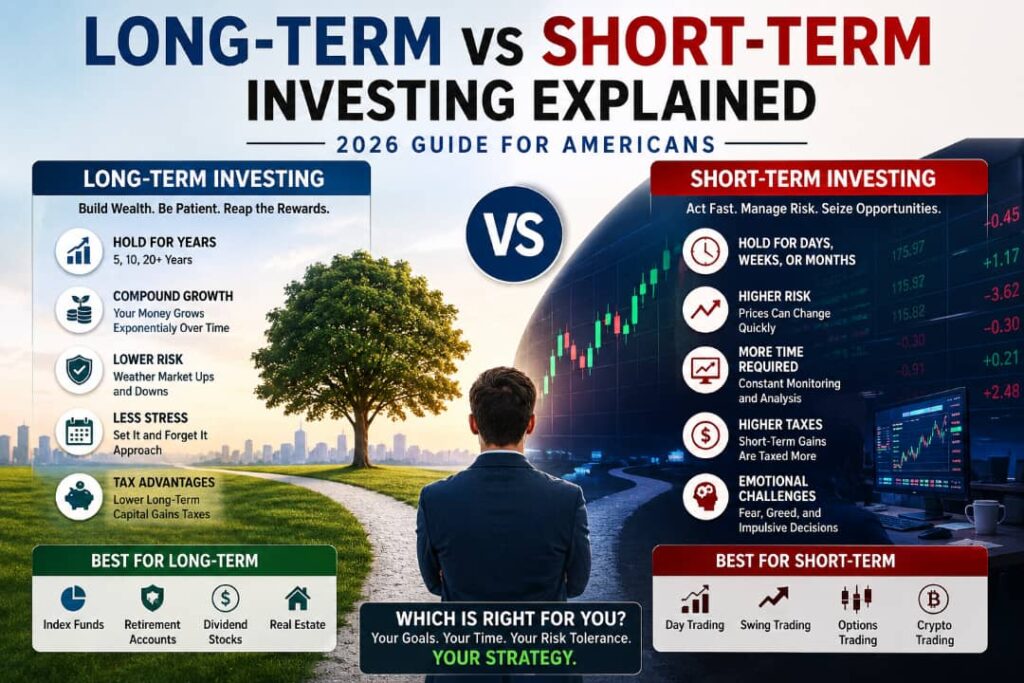
If you’re starting your investing journey, chances are you’ve already come across two popular strategies: long-term investing and short-term investing. Simply put, at first glance, they may sound similar—they both involve putting your money into assets with the hope of making a profit. But in reality, they’re completely different approaches that require different mindsets, levels of patience, and risk tolerance.
And here’s the truth: choosing the wrong strategy for your personality and financial goals can lead to frustration, emotional stress, and costly mistakes.
For millions of Americans in 2026, investing has become more important than ever. With rising living costs, inflation concerns, and growing interest in financial independence, more people are trying to figure out how to grow their money wisely.
Some people want slow and steady wealth over decades. Others want faster profits and enjoy the excitement of active trading. Neither approach is automatically “right” or “wrong”—but understanding how each works can help you make smarter financial decisions.
So, should you buy stocks and hold them for years? Or should you actively trade and chase short-term gains?
Let’s break it all down in simple, conversational language.
What Is Long-Term Investing?
Long-term investing is exactly what it sounds like: buying investments and holding them for many years—sometimes even decades.
Instead of trying to make quick money, long-term investors focus on allowing their investments to grow steadily over time. As it turns out, they believe patience is one of the most powerful tools in wealth building.
Long-term investing typically relies on:
- Compound interest
- Overall market growth
- Dividend reinvestment
- Business expansion over time
Rather than obsessing over daily stock market movements, long-term investors focus on the bigger picture.
For example, someone might regularly invest money into the S&P 500 through index funds and leave it untouched for 20 or 30 years.
That may sound boring compared to flashy trading videos online—but historically, it’s been one of the most effective ways to build wealth in America.
Common long-term investments include:
- Stocks
- ETFs
- Index funds
- Retirement accounts
- Dividend stocks
- Real estate
What Is Short-Term Investing?
Short-term investing is much faster-paced.
Instead of waiting years for investments to grow, short-term investors aim to profit from smaller price movements over shorter periods—sometimes within days or even hours.
This style of investing includes strategies like:
- Day trading
- Swing trading
- Cryptocurrency trading
- Forex trading
- Options trading
Short-term investors constantly watch the market, looking for opportunities to buy low and sell high quickly.
Unlike long-term investors, short-term traders often spend big time:
- Studying charts
- Following financial news
- Monitoring price patterns
- Managing risk closely
For some people, this feels exciting and rewarding. For others, it feels stressful and overwhelming.
The Main Difference Between Long-Term and Short-Term Investing
The biggest difference comes down to one simple thing:
Time.
Long-term investors think in years.
Short-term investors think in days, weeks, or months.
One strategy focuses on patience and consistency.
The other focuses on speed and timing.
Why Long-Term Investing Has Worked for So Many Americans
There’s a reason most financial experts recommend long-term investing—because historically, it works.
The U.S. stock market has experienced crashes, recessions, inflation, wars, and economic uncertainty over the decades. Yet despite all of that, the market has continued growing over the long run.
That’s why many legendary investing books encourage patience over hype.
Books like The Intelligent Investor and The Simple Path to Wealth repeatedly emphasize discipline, consistency, and emotional control.
One of the most famous investing quotes from Warren Buffett says:
“The stock market is a device for transferring money from the impatient to the patient.”
That quote perfectly captures why long-term investing continues to outperform many quick-money strategies.
The Biggest Advantage of Long-Term Investing: Compound Growth
Compound growth is one of the most powerful financial concepts in the world.
Here’s how it works:
Your investments earn returns.
Then those returns begin earning returns too.
Over time, the snowball gets bigger and bigger.
For example:
- Investing $500 every month
- Earning an average annual return of 10%
- Continuing for 30 years
Could potentially grow into over $1 million.
That’s not magic—it’s consistency plus time.
Books like The Psychology of Money explain that building wealth often has less to do with intelligence and more to do with patience and behavior.
Why Many People Prefer Long-Term Investing
1. It’s Less Stressful
Long-term investors don’t need to panic every time the stock market dips.
They understand that market fluctuations are normal.
Instead of reacting emotionally, they stay focused on long-term goals.
For busy Americans balancing work, family, and bills, this approach is often much more realistic.
2. It Requires Less Time
You don’t need to stare at charts all day.
Many successful long-term investors simply:
- Invest consistently
- Diversify their portfolio
- Reinvest dividends
- Stay patient
That’s it.
This simplicity is why passive investing has become so popular in the United States.
3. Taxes Can Be Lower
In America, long-term investments usually receive better tax treatment than short-term trades.
If you hold investments for more than a year, you may qualify for lower long-term capital gains tax rates.
Short-term traders often pay higher ordinary income tax rates instead.
Over time, that tax difference can significantly impact profits.
The Downsides of Long-Term Investing
Of course, no strategy is perfect.
1. Wealth Building Takes Time
This is the part many beginners struggle with.
Long-term investing is not exciting every day.
There are no overnight riches.
Building real wealth often takes years of discipline and consistency.
2. Market Crashes Can Feel Scary
Even experienced investors get nervous during major downturns.
Events like:
- The 2008 financial crisis
- The 2020 COVID market crash
- Inflation-driven corrections
Can test your patience.
Long-term investing works best when investors avoid panic selling.
Why Short-Term Investing Attracts So Many People
Let’s be honest: short-term investing sounds exciting.
The idea of making money quickly attracts millions of people every year.
Social media is full of stories about traders turning small accounts into huge profits overnight.
And yes, some people do succeed.
But short-term investing is much harder than it looks online.
Benefits of Short-Term Investing
1. Faster Profit Potential
Skilled traders can sometimes earn money quickly during volatile market movements.
This appeals to people looking for quicker financial results.
2. More Active Involvement
Some investors genuinely enjoy analyzing charts, studying trends, and actively managing trades.
For them, investing becomes both a skill and a hobby.
3. Opportunities During Market Volatility
Short-term traders can potentially profit whether markets go up or down.
That flexibility attracts many experienced traders.
The Risks of Short-Term Investing
Here’s where many beginners run into problems.
1. Higher Risk
Short-term investing is significantly riskier.
Markets move unpredictably in the short run, and many traders lose money trying to time them perfectly.
Research consistently shows that most active traders underperform long-term investors over time.
2. Emotions Can Take Over
Fear and greed are powerful emotions.
Short-term traders often struggle with:
- Panic selling
- Overtrading
- Chasing trends
- Revenge trading after losses
Books like Trading in the Zone explain how psychology heavily affects trading success.
3. Honestly, it Can Feel Like a Full-Time Job
Many traders spend hours every day:
- Watching charts
- Reading market news
- Managing trades
- Monitoring risk
For people with busy schedules, this level of commitment can become exhausting.
Which Investing Style Is Better for Beginners?
For most Americans in 2026, long-term investing is usually the better starting point.
Why?
Because it’s:
- Easier to understand
- Less stressful
- More predictable
- Simpler to maintain
- Historically effective
Many experts recommend starting with diversified index funds before attempting advanced trading strategies.
Books like A Random Walk Down Wall Street strongly support passive long-term investing for ordinary investors.
Can You Combine Both Strategies?
Absolutely.
In fact, many investors do exactly that.
A common approach looks like this:
- 80–90% in long-term investments
- 10–20% in short-term trading opportunities
This strategy allows investors to build stable long-term wealth while still experimenting with active trading if they enjoy it.
Common Mistakes Investors Make
Trying to Get Rich Fast
This is probably the biggest investing mistake of all.
Social media often highlights massive wins while hiding massive losses.
Real wealth usually grows slowly and steadily.
Investing Without a Plan
Before investing, you should understand:
- Your goals
- Your risk tolerance
- Your timeline
- Your strategy
Without a plan, emotions usually take control.
Ignoring Diversification
Putting all your money into one stock or one cryptocurrency is risky.
Diversification helps reduce the impact of losses.
Recommended Investing Books for Beginners
If you want to improve your investing knowledge, these are excellent books to start with:
These also make excellent affiliate product recommendations for finance-focused websites.
Final Thoughts
At the end of the day, both long-term and short-term investing can help you grow wealth—but they require very different mindsets.
If your goal is steady financial growth, retirement security, and less stress, long-term investing is usually the smarter path.
If you enjoy fast-paced decision-making and understand the risks involved, short-term trading may appeal to you.
But for most Americans, the real secret to investing success isn’t finding the “perfect” stock.
It’s staying consistent, staying patient, and giving your investments enough time to grow.
Because in investing, time is often more powerful than timing.
Frequently Asked Questions (FAQs)
1. What is the main difference between long-term and short-term investing?
The main difference is time. Long-term investing means holding investments for years or decades to build wealth slowly, while short-term investing focuses on making quicker profits over days, weeks, or months.
2. Which is better: long-term or short-term investing?
For most beginners in the U.S., long-term investing is generally better because it is simpler, less risky, and more consistent. Short-term investing can be profitable but requires experience, time, and strong risk management skills.
3. Can I make money faster with short-term investing?
Yes, short-term investing can produce faster gains, but it also comes with higher risk. Many traders also experience losses, especially if they lack experience or emotional control.
4. Is long-term investing safe?
Long-term investing is considered safer than short-term trading because it spreads risk over time. While markets go up and down, historically they have grown over the long run.
5. How much money do I need to start investing?
You can start investing in the U.S. with as little as $10–$100 using brokerage apps and index funds. The key is consistency, not the starting amount.
6. What are the best long-term investments for beginners?
Popular long-term investments include:
- Index funds (like the S&P 500)
- ETFs
- Retirement accounts (401(k), IRA)
- Dividend stocks
- Real estate
7. Is short-term investing like day trading risky?
Yes, day trading and other short-term strategies are high-risk. Many beginners lose money due to emotional decisions, lack of strategy, and market volatility.
8. Do I need experience to start short-term trading?
Yes. Short-term trading requires knowledge of charts, technical analysis, risk management, and discipline. Without experience, it is easy to lose money quickly.
9. How long should I hold long-term investments?
Long-term investments are usually held for at least 5–10 years, but many investors hold them for 20–30 years or more to maximize compound growth.
10. What is compound interest in investing?
Compound interest is when your investment earnings generate additional earnings over time. It is one of the most powerful ways to grow wealth in long-term investing.
11. Can I combine long-term and short-term investing?
Yes. Many investors use a hybrid approach—most of their money goes into long-term investments, while a smaller portion is used for short-term trading opportunities.
12. Why do most investors prefer long-term investing?
Long-term investing is popular because it is easier to manage, less stressful, has tax advantages, and historically provides more stable returns over time.
13. What are the biggest mistakes beginners make in investing?
Common mistakes include:
- Trying to get rich quickly
- Not diversifying investments
- Panic selling during market drops
- Investing without a plan
- Overtrading in short-term markets
14. Are index funds good for long-term investing?
Yes, index funds are one of the most recommended long-term investment tools because they offer diversification, low fees, and consistent market exposure.
15. Can investing help me achieve financial freedom?
Yes, investing—especially long-term investing—can help build wealth over time and support financial independence when combined with consistent saving and smart planning.