
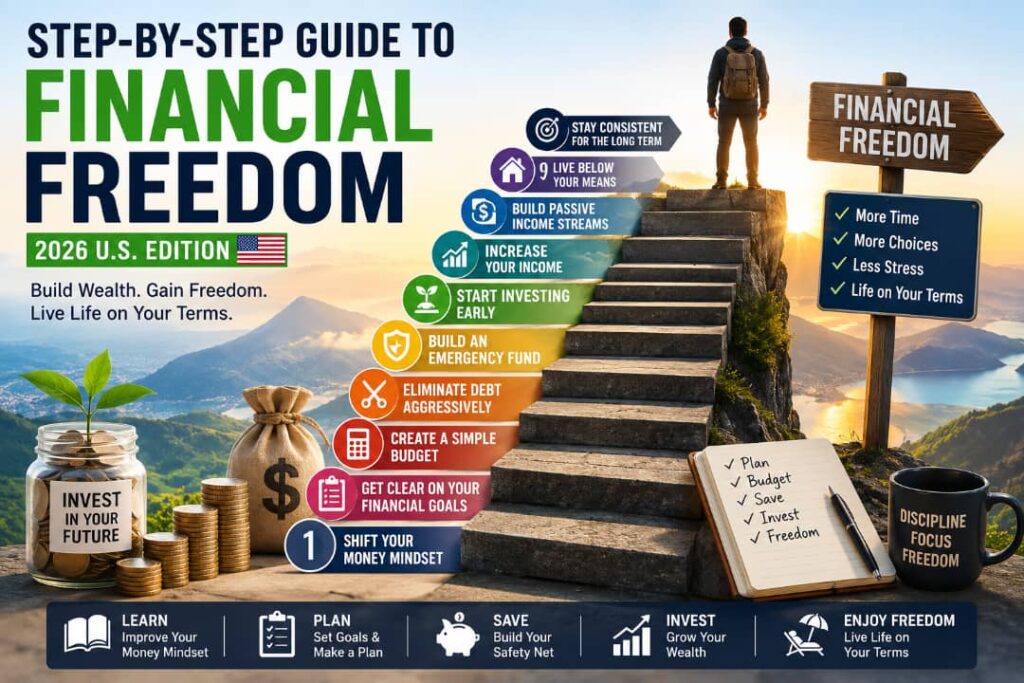
Let’s be real for a second—financial freedom isn’t about getting rich overnight. It’s not some viral “make money fast” trick or a lucky break. It’s about something much more powerful: having control over your life.
Control over your time.
Control over your income.
Control over the choices you make every day.
For many Americans, that simply means:
- Not stressing about bills
- Getting out of debt
- Having money work for you instead of always working for money
And the good news? There’s a roadmap. Not a guess—a proven path that’s been followed by millions of people, backed by some of the most respected personal finance books ever written.
Let’s walk through it together—step by step.
Step 1: Change How You Think About Money
Before you earn more, save more, or invest—you have to think differently about money.
One of the simplest but most powerful ideas comes from Rich Dad Poor Dad:
Wealthy people buy assets. Everyone else buys liabilities.
That means:
- Assets = things that make you money
- Liabilities = things that take money out of your pocket
Sounds obvious, but most people live the opposite way.
Another eye-opener comes from The Psychology of Money, which basically says:
It’s not how smart you are—it’s how you behave with money.
In other words, your habits matter more than your income..
Step 2: Know What “Financial Freedom” Means to You
Here’s the truth: financial freedom looks different for everyone.
For some people, it means:
- Retiring early
- Quitting a 9–5 job
- Traveling more
- Or just sleeping peacefully without money stress
Books like Your Money or Your Life focus on this exact idea—aligning your money with your life goals.
Ask yourself:
- “How much do I actually need each month to feel free?”
- “What kind of life do I want to live?”
For example, if you need $4,000/month to live comfortably, your mission becomes simple:
 Build income streams that generate $4,000/month.
Now you have a target. That’s powerful.
Step 3: Keep Your Budget Simple (Seriously)
Most people fail at budgeting because they overcomplicate it.
Tracking every coffee? That’s exhausting.
A better approach—like the one in I Will Teach You to Be Rich—is to automate your finances and keep things simple.
Try this:
- 50–60% → Needs (rent, bills, groceries)
- 20–30% → Wants (fun, lifestyle)
- 20% → Saving & investing
Even better? Automate everything:
- Savings go out automatically
- Investments happen in the background
That’s exactly what The Automatic Millionaire teaches—set it and let it run.
Step 4: Get Rid of Debt (As Fast As You Can)
Let’s not sugarcoat it—debt slows everything down.
Especially:
- Credit card debt
- High-interest loans
- Car payments
One of the most popular strategies comes from The Total Money Makeover: the debt snowball method.
Here’s how it works:
- Pay off your smallest debt first
- Build momentum
- Roll those payments into the next debt
It’s not just about math—it’s about motivation.
Because here’s the reality:
It’s extremely hard to build wealth while paying 20% interest on debt.
Step 5: Build Your Safety Net
Before you start investing heavily, you need a cushion.
Life happens:
- Jobs change
- Emergencies pop up
- Unexpected bills appear
That’s why experts recommend saving 3–6 months of expenses.
Books like The Millionaire Next Door highlight something surprising:
Most wealthy people aren’t flashy—they’re prepared.
They save. They plan. They protect their money.
Step 6: Start Investing (Even If It’s Small)
This is where things start to change.
You don’t need thousands of dollars to begin. You just need consistency.
The Simple Path to Wealth keeps it clear:
- Invest in low-cost index funds
- Keep it simple
- Stay consistent
If you’re in the U.S., common starting points include:
- 401(k) (especially with employer match)
- Roth IRA
- Basic brokerage accounts
Another great principle from The Little Book of Common Sense Investing:
Keep fees low and think long-term.
No hype. No chasing trends. Just steady growth.
Step 7: Earn More (This Changes Everything)
Cutting expenses helps—but there’s a limit.
Increasing your income? That’s where real acceleration happens.
In 2026, Americans have more opportunities than ever:
- Freelancing
- Affiliate marketing
- Remote jobs
- Selling digital products
- Starting online businesses
Books like Set for Life emphasize this clearly:
You need both—higher income AND smart investing.
Because saving $200/month is good…
But earning an extra $2,000/month? That’s a game changer.
Step 8: Build Income That Doesn’t Depend on Your Time
This is the turning point.
Instead of trading hours for money, you start building systems that pay you.
Examples:
- Dividend stocks
- Rental income
- Affiliate websites
- Digital products
- Online businesses
This is the core idea behind financial freedom:
Income that keeps coming in—even when you’re not working.
Imagine earning $1,000/month from a blog or investment.
Now imagine stacking multiple streams like that.
That’s how freedom is built.
Step 9: Don’t Upgrade Your Lifestyle Too Fast
This one trips up a lot of people.
As income increases, so does spending:
- Bigger house
- Better car
- More expensive habits
This is called lifestyle inflation—and it quietly keeps people stuck.
But studies and books like The Millionaire Next Door show something interesting:
Many millionaires live below their means.
They don’t try to look rich. They focus on staying rich.
Simple rule: Always spend less than you earn—no matter how much you make.
Step 10: Stay Consistent (This Is the Secret)
Here’s the part most people underestimate:
Financial freedom doesn’t come from one big move.
It comes from small, consistent actions over time.
- Investing regularly
- Avoiding emotional decisions
- Sticking to your plan
It’s not exciting—but it works.
A Simple Financial Freedom Plan (Keep This)
If you want to simplify everything, just follow this:
- Learn about money
- Control your spending
- Eliminate debt
- Build savings
- Invest consistently
- Increase your income
- Create passive income
- Repeat and grow
That’s it. No shortcuts—just a system.
Final Thoughts
Financial freedom isn’t reserved for the lucky or the wealthy.
It’s built step by step, decision by decision.
It’s not about:
- Timing the market
- Finding a “secret trick”
- Getting rich fast
It’s about:
Showing up consistently
Making smarter choices
Playing the long game
?? Frequently Asked Questions
1. What is financial freedom and how do I achieve it?
Financial freedom means having enough income from your savings, investments, or businesses to cover your living expenses—without depending on a paycheck.
You achieve it by:
- Spending less than you earn
- Eliminating debt
- Investing consistently
- Building multiple income streams
A great starting point is reading Rich Dad Poor Dad, which explains the difference between assets and liabilities in a very simple way.
2. How much money do I need to be financially free?
There’s no one-size-fits-all number—it depends on your lifestyle.
A simple formula:
Monthly expenses × 25 = Financial freedom number
So if you need $4,000/month, you’ll need about $1,000,000 invested (based on the 4% rule).
Books like The Simple Path to Wealth explain this concept in a very practical way.
.
3. Can I achieve financial freedom on an average salary?
Yes—many Americans do it without earning huge incomes.
The key is:
- Consistency
- Smart spending
- Investing early
The Millionaire Next Door shows that most millionaires live below their means and build wealth slowly over time.
4. What’s the fastest way to reach financial freedom?
There’s no “instant” way—but you can speed things up by:
- Increasing your income (side hustles, online business)
- Investing aggressively
- Avoiding bad debt
Set for Life emphasizes boosting income early to accelerate your journey.
5. Should I pay off debt or invest first?
In most cases, you should pay off high-interest debt first (like credit cards).
Why? Because the interest you’re paying is often higher than investment returns.
The Total Money Makeover recommends focusing on debt elimination before heavy investing.
.
6. How much should I save each month?
A common rule is:
Save at least 20% of your income
If that feels too high, start small—even 5–10% is better than nothing.
The Automatic Millionaire teaches that automating small savings consistently can lead to big results over time.
7. What are the best investments for beginners in the U.S.?
For most beginners, simple is better:
- Index funds
- ETFs
- Retirement accounts like 401(k) and Roth IRA
The Little Book of Common Sense Investing strongly recommends low-cost index investing for long-term growth.
8. How do I build passive income?
Passive income comes from assets that generate money with little ongoing effort.
Popular options:
- Dividend stocks
- Rental properties
- Affiliate marketing
- Digital products
The key idea from Financial Freedom is to focus on income-producing assets.
9. How long does it take to achieve financial freedom?
It depends on:
- Your income
- Your savings rate
- Your investments
For most people, it takes 10–25 years—but it can be faster if you:
- Earn more
- Invest more
- Stay consistent
Your Money or Your Life focuses on aligning spending and saving to speed up the process.
10. Do I need multiple income streams to become financially free?
Yes—this is one of the most effective strategies.
Relying on one income source is risky. Multiple streams give you:
- Stability
- Faster growth
- More freedom
The Psychology of Money highlights how smart financial behavior and diversification reduce risk.
11. What mistakes should I avoid on the path to financial freedom?
Common mistakes include:
- Living beyond your means
- Ignoring investing
- Taking on high-interest debt
- Chasing “get rich quick” schemes
Most financial books agree: discipline beats shortcuts every time.
12. Is financial freedom realistic for beginners in 2026?
Yes—arguably more than ever.
With:
- Remote work opportunities
- Online businesses
- Investment apps
…it’s easier than ever to start.
The key is taking action and following proven systems from trusted resources like Rich Dad Poor Dad and The Simple Path to Wealth.