
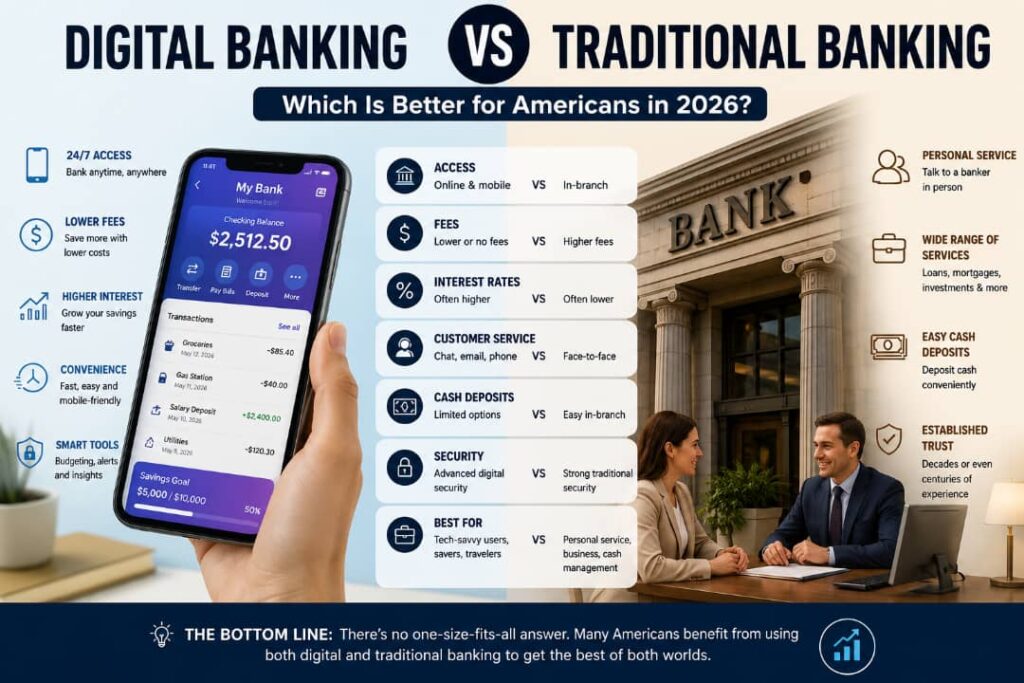
Banking looks very different today than it did just a decade ago. Not long ago, most Americans visited a local branch whenever they needed to deposit a check, open an account, or talk to a banker. Today, many people manage their entire financial lives from their smartphones.
As we move through 2026, consumers have more banking choices than ever before. Traditional banks continue to serve millions of customers across the United States, offering in-person support and a familiar banking experience. At the same time, digital banks have surged in popularity by promising lower fees, higher savings rates, and the convenience of banking from anywhere.
So which option is better?
The truth is that there isn’t a one-size-fits-all answer. The right choice depends on your financial goals, daily habits, and what you value most from a banking relationship.
In this guide, we’ll take a closer look at digital banking and traditional banking, compare their strengths and weaknesses, and help you decide which approach makes the most sense for your financial future.
What Is Digital Banking?
Digital banking is exactly what it sounds like—banking that happens primarily online. Instead of relying on physical branches, digital banks operate through websites and mobile apps, giving customers access to financial services wherever they have an internet connection.
For many Americans, that level of convenience is a game-changer.
Need to deposit a check? Take a photo with your phone. Want to transfer money to a friend? A few taps can get it done. Need to check your account balance while standing in line for coffee? No problem.
Modern digital banks allow customers to:
- Open accounts online in minutes
- Deposit checks remotely
- Transfer money between accounts
- Pay bills automatically
- Track spending in real time
- Apply for loans
- Manage savings goals
Many digital banking platforms also come with features that weren’t common just a few years ago. Real-time spending alerts, automated savings tools, personalized budgeting insights, and high-yield savings accounts have become standard offerings.
The popularity of digital banking reflects a broader shift toward convenience and automation. In his bestselling book Atomic Habits, James Clear explains that people are more likely to stick with positive behaviors when those behaviors are easy and accessible. Digital banking follows the same principle by making money management simple enough to fit into everyday life.
What Is Traditional Banking?
Traditional banking refers to the familiar model most Americans grew up with—financial institutions that operate physical branches where customers can receive in-person assistance.
While technology has become an important part of traditional banking, the branch experience remains a key difference.
Traditional banks typically offer a wide range of services, including:
- Checking accounts
- Savings accounts
- Mortgages
- Personal loans
- Business banking
- Investment services
- Financial planning
For many customers, the ability to walk into a branch and speak directly with a banker provides a level of confidence that digital-only institutions cannot fully replicate.
Whether you’re discussing a mortgage application, resolving a complicated account issue, or planning for retirement, face-to-face conversations can still be incredibly valuable.
There’s also something reassuring about knowing a physical location exists if you need help. That’s one reason traditional banks continue to maintain strong customer loyalty despite growing competition from digital alternatives.
How Banking Has Changed in America
The way Americans interact with banks has evolved dramatically over the last twenty years.
Mobile banking apps have transformed from simple account-viewing tools into powerful financial management platforms. Today, many consumers rarely visit a branch at all.
This trend is especially noticeable among Millennials and Gen Z, who often evaluate banks based on the quality of their mobile apps rather than the number of nearby branch locations.
At the same time, expectations have changed. Consumers want instant access, seamless transfers, personalized financial insights, and services that work around their schedules—not the other way around.
These changes align with ideas discussed in The Psychology of Money by Morgan Housel. One of the book’s central themes is that successful money management often comes down to consistent habits rather than complex strategies. Digital banking tools help reinforce those habits through automation, spending notifications, and savings features that make financial discipline easier.
Still, traditional banks haven’t become obsolete. Far from it.
Many Americans continue to value personal relationships, professional guidance, and the security of working with institutions that have served their communities for generations.
That’s why the debate isn’t really about whether one system will replace the other. Instead, it’s about understanding where each option excels and determining which one best fits your financial lifestyle.
Advantages of Digital Banking
Lower Fees
One of the biggest reasons consumers switch to digital banking is simple: it can save money.
Because digital banks don’t have to maintain large networks of branches, they often operate with lower overhead costs. Many pass those savings directly to customers through reduced fees and more competitive account offerings.
It’s common to find digital banks that offer:
- No monthly maintenance fees
- No minimum balance requirements
- Lower overdraft fees
- Free transfers and online services
For Americans trying to stretch every dollar, these savings can add up significantly over time.
Higher Interest Rates
If you’re focused on growing your savings, digital banking often has another major advantage.
Many online banks offer substantially higher annual percentage yields (APYs) than traditional institutions. While rates change over time, digital banks frequently lead the market when it comes to rewarding savers.
That means your emergency fund, vacation fund, or long-term savings account could grow faster simply because your money is earning more interest.
Banking Anytime, Anywhere
Convenience may be the single biggest selling point of digital banking.
Whether you’re traveling across the country, working late, or relaxing at home, your bank is available whenever you need it.
There are no branch hours to worry about and no need to rearrange your schedule just to complete basic banking tasks.
For busy professionals and modern families, that flexibility can make a meaningful difference.
Frequently Asked Questions (FAQs)
1. What is the main difference between digital banking and traditional banking?
The primary difference is that digital banks operate mainly online through mobile apps and websites, while traditional banks maintain physical branch locations where customers can receive in-person assistance. Digital banks focus on convenience and lower costs, whereas traditional banks emphasize face-to-face service and a broader range of financial products.
2. Are digital banks safe to use in 2026?
Yes. Most reputable digital banks use advanced security measures such as encryption, multi-factor authentication, fraud monitoring, and secure login systems. Customers should still practice good cybersecurity habits, including using strong passwords and enabling two-factor authentication.
3. Do digital banks offer higher interest rates than traditional banks?
In many cases, yes. Digital banks often offer higher annual percentage yields (APYs) on savings accounts because they have lower operating costs than traditional banks with extensive branch networks.
4. Can I deposit cash into a digital bank account?
Some digital banks allow cash deposits through partner retail locations or ATM networks. However, cash deposits are generally more convenient with traditional banks that operate physical branches.
5. Which type of bank has lower fees?
Digital banks typically have fewer fees, including lower or no monthly maintenance fees, reduced overdraft fees, and no minimum balance requirements. Traditional banks may charge more fees due to higher operational costs.
6. Is digital banking better for young professionals?
Digital banking is often a great fit for young professionals because it offers mobile access, budgeting tools, automated savings features, and the convenience of managing finances from anywhere.
7. Who should consider using a traditional bank?
Traditional banks may be ideal for individuals who value in-person customer service, frequently deposit cash, own small businesses, need financial planning assistance, or prefer face-to-face interactions with banking professionals.
8. Can I use both a digital bank and a traditional bank?
Absolutely. Many financial experts recommend using both. A traditional bank can handle cash deposits and complex banking needs, while a digital bank can provide higher savings rates and convenient everyday banking tools.
9. Do digital banks offer checking accounts?
Yes. Most digital banks offer checking accounts with features such as debit cards, mobile check deposits, online bill pay, and fee-free transfers.
10. Are traditional banks becoming obsolete?
No. While digital banking continues to grow, traditional banks still play an important role by providing personalized service, business banking solutions, mortgages, investment advice, and physical branch access.
11. Which banking option is better for small business owners?
Many small business owners prefer traditional banks because of their cash-handling capabilities, business lending services, and access to relationship managers. However, some digital banks offer competitive business banking solutions as well.
12. Do digital banks offer loans and credit products?
Yes. Many digital banks provide personal loans, credit-building products, mortgages, and other lending services through their online platforms.
13. What are the biggest advantages of digital banking?
The main advantages include lower fees, higher savings rates, 24/7 account access, powerful budgeting tools, automated savings features, and a convenient mobile-first experience.
14. What are the biggest advantages of traditional banking?
Traditional banks provide personal customer service, physical branch access, easier cash deposits, comprehensive financial products, and professional guidance for complex financial situations.
15. How will banking change in the future?
The future of banking is expected to include more artificial intelligence, personalized financial recommendations, faster payment systems, improved mobile experiences, enhanced security features, and greater integration between digital and traditional banking services.
16. Is digital banking good for building savings?
Yes. Many digital banks offer automated savings tools, spending insights, and higher interest rates that can help customers build emergency funds and achieve long-term financial goals more effectively.
17. What should I consider before choosing a bank?
When choosing a bank, consider factors such as fees, interest rates, customer service, mobile app quality, ATM access, branch availability, security features, and the types of financial products you need.
18. Which is better in 2026: digital banking or traditional banking?
Neither option is universally better. Digital banking is ideal for convenience, lower costs, and technology-focused users, while traditional banking excels in personal service and comprehensive financial support. Many Americans benefit from combining both approaches.