
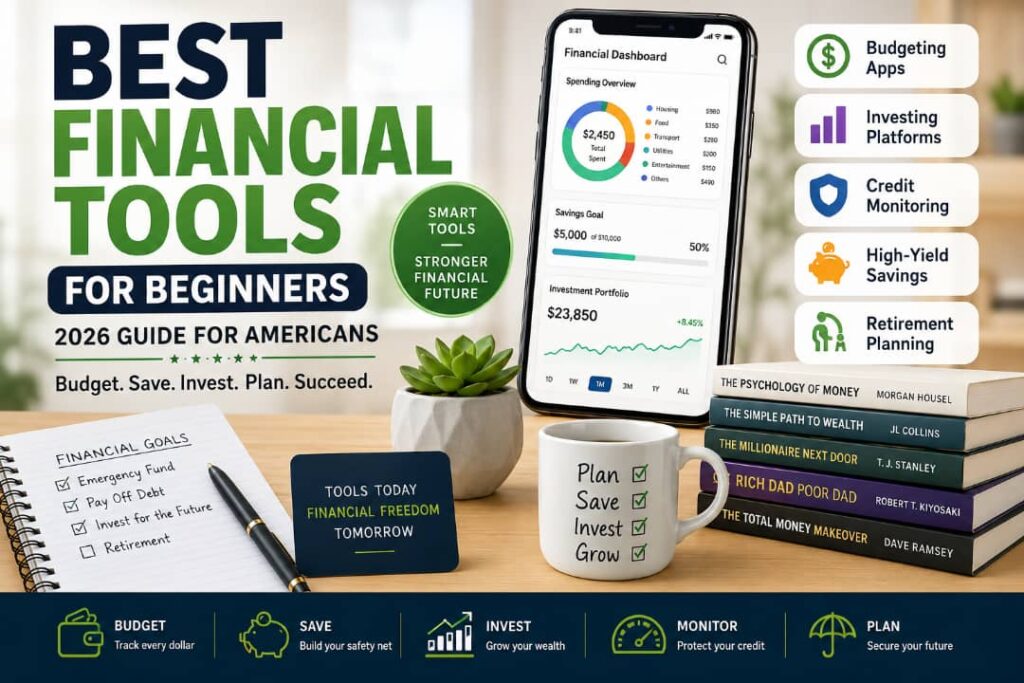
Getting your finances under control can feel overwhelming when you’re just starting out. Between budgeting, saving, investing, building credit, and planning for retirement, there’s a lot to learn. The good news? You don’t have to figure everything out on your own.
In 2026, Americans have access to a wide range of financial tools designed to make managing money easier than ever. Whether you’re a recent college graduate, a young professional, or simply looking to improve your financial situation, the right tools can help you make smarter decisions and build confidence with your money.
The truth is that financial success isn’t about being a math genius. It’s about developing good habits and using systems that keep you on track. That’s why choosing the right financial tools can be one of the smartest decisions you make.
In this guide, we’ll explore the best financial tools for beginners, how they work, and why they can help you build a stronger financial future.
Why Financial Tools Are Worth Using
Imagine trying to drive across the country without a GPS. You might eventually reach your destination, but you’ll probably make a few wrong turns along the way.
Managing your finances without the right tools is similar. You can certainly do it, but it’s much easier when you have systems that help track your progress and keep you organized.
One of the most important lessons from The Psychology of Money by Morgan Housel is that financial success often comes down to behavior rather than knowledge. The best financial tools encourage good behaviors—saving consistently, spending intentionally, and investing regularly.
Let’s look at some of the most useful tools available to beginners today.
1. Budgeting Apps: The Foundation of Financial Success
If you’re serious about improving your finances, budgeting is where everything starts.
Many people are surprised when they discover how much money slips through their fingers each month. A few streaming subscriptions here, daily coffee runs there, and suddenly hundreds of dollars have disappeared.
Budgeting apps help solve this problem by showing exactly where your money is going.
Why They’re Helpful
- Track spending automatically
- Categorize expenses
- Create savings goals
- Monitor monthly cash flow
- Build better money habits
Whether you’re trying to pay off debt or save for a vacation, a budgeting app can give you a clear picture of your financial situation.
Dave Ramsey emphasizes this principle in The Total Money Makeover, where he teaches that every dollar should have a job. Budgeting apps make that process significantly easier.
2. High-Yield Savings Accounts: Put Your Savings to Work
Many Americans still keep their emergency savings in traditional bank accounts that earn very little interest.
That’s a missed opportunity.
A high-yield savings account allows your money to grow while remaining easily accessible when you need it.
Best Uses for a High-Yield Savings Account
- Emergency funds
- Home down payment savings
- Vacation funds
- Major purchases
- Short-term financial goals
Even though you’re not going to become wealthy from the interest alone, earning more on money you’re already saving is a smart move.
Most financial experts recommend keeping three to six months of living expenses in an emergency fund before focusing heavily on investing.
3. Investment Apps: Making Investing More Accessible
Not long ago, investing felt complicated and expensive.
Today, investment apps have changed the game completely.
Many platforms allow beginners to buy fractional shares, meaning you can invest in large companies without needing hundreds or thousands of dollars upfront.
Benefits of Investment Apps
- Low minimum investments
- Automatic investing options
- Educational resources
- Easy portfolio tracking
- User-friendly interfaces
This accessibility has helped millions of Americans start investing earlier than previous generations.
In The Simple Path to Wealth, JL Collins explains that consistent investing often matters far more than trying to find the next big stock market winner. Investment apps make consistency easier.
4. Robo-Advisors: Investing on Autopilot
If building an investment portfolio sounds intimidating, robo-advisor8s may be exactly what you’re looking for.
These platforms ask a few questions about your goals, timeline, and comfort with risk. From there, they automatically build and manage a diversified investment portfolio for you.
Why Beginners Like Robo-Advisors
- Automated investing
- Portfolio diversification
- Lower fees than many traditional advisors
- Automatic rebalancing
- Retirement planning support
For people who prefer a hands-off approach, robo-advisors remove much of the guesswork from investing.
Perhaps even more importantly, they help prevent emotional decision-making—a common mistake among new investors.
5. Credit Monitoring Tools: Protecting Your Financial Future
Your credit score plays a much bigger role in your life than many people realize.
A strong credit score can help you qualify for better mortgage rates, lower-interest car loans, and more favorable credit card offers.
Credit monitoring tools help you stay informed and catch potential problems before they become serious.
Key Benefits
- Credit score tracking
- Fraud alerts
- Credit report monitoring
- Identity protection
- Financial awareness
Improving your credit score can potentially save thousands of dollars over your lifetime through lower borrowing costs.
That’s why credit monitoring is one of the most underrated financial tools available.
6. Retirement Planning Tools: Giving Your Future Self a Head Start
Retirement may seem decades away, especially if you’re in your twenties or thirties.
However, time is one of the most powerful assets an investor can have.
Retirement calculators and planning tools help you estimate how much you’ll need to save and whether you’re currently on track to meet your goals.
What Retirement Tools Can Help You Do
- Set retirement goals
- Estimate future account balances
- Calculate contribution targets
- Visualize long-term growth
- Adjust your strategy as needed
As highlighted in The Millionaire Next Door, many financially successful Americans aren’t necessarily high earners. They’re consistent savers who plan for the long term.
7. Debt Payoff Calculators: Creating a Clear Exit Strategy
Debt can feel overwhelming, especially when multiple balances are involved.
The good news is that debt payoff calculators can help create a clear roadmap.
Instead of wondering where to start, you’ll know exactly how much progress you’re making and how long it may take to become debt-free.
Common Debts These Tools Help Manage
- Credit cards
- Student loans
- Auto loans
- Personal loans
Many calculators also allow you to compare different repayment strategies.
Debt Snowball Method
Focus on paying off the smallest balance first for quick wins.
Debt Avalanche Method
Focus on the highest-interest debt first to save money over time.
Both approaches work. The best choice depends on what keeps you motivated.
8. Net Worth Tracking Tools: Measuring What Really Matters
Income is important, but it doesn’t tell the whole story.
A person earning $200,000 per year with significant debt may be less financially secure than someone earning $80,000 with substantial investments and minimal debt.
That’s why tracking net worth is so valuable.
Net Worth Formula
Assets – Liabilities = Net Worth
Net worth tracking tools allow you to see your overall financial progress in one place.
Benefits
- Monitor wealth growth
- Track debt reduction
- Stay motivated
- Measure long-term progress
Many self-made millionaires focus heavily on growing net worth rather than simply increasing income.
9. Tax Software: Making Tax Season Less Stressful
Let’s be honest—few people look forward to filing taxes.
Fortunately, tax preparation software has made the process much simpler.
Today’s tax tools guide users through each step, helping identify deductions and reducing the likelihood of costly mistakes.
Benefits of Tax Software
- Easy step-by-step guidance
- Faster filing
- Error checking
- Refund optimization
- Electronic submission
Understanding taxes may not be exciting, but it can have a significant impact on your financial health.
10. Financial Education Platforms: The Tool That Powers Everything Else
While apps and calculators are useful, the most valuable financial tool is still education.
The more you understand about money, the better decisions you’ll make.
Financial education platforms can teach you about investing, budgeting, retirement planning, taxes, credit scores, and wealth building.
Must-Read Personal Finance Books
The Psychology of Money — Morgan Housel
A fascinating look at how behavior influences financial outcomes.
Rich Dad Poor Dad — Robert Kiyosaki
Introduces key concepts around assets, liabilities, and financial independence.
The Simple Path to Wealth — JL Collins
One of the most beginner-friendly investing books available.
The Millionaire Next Door — Thomas J. Stanley
Explores the habits and behaviors of self-made millionaires.
The Total Money Makeover — Dave Ramsey
Provides practical advice for budgeting and eliminating debt.
Even reading one of these books can dramatically improve your financial knowledge.
How to Choose the Right Financial Tools
Not every tool is a perfect fit for every person.
Before choosing one, ask yourself a few questions.
What Are Your Goals?
Are you trying to:
- Save money?
- Eliminate debt?
- Start investing?
- Build retirement savings?
Your goals should guide your choices.
How Much Time Can You Commit?
Some tools require active involvement, while others automate most of the work.
What’s Your Experience Level?
If you’re a beginner, simplicity is often better than advanced features you’ll never use.
What’s Your Budget?
The good news is that many excellent financial tools are either free or very affordable.
Common Mistakes Beginners Make
As helpful as financial tools can be, they’re not magic.
Here are a few mistakes to avoid.
Trying Too Many Tools at Once
Start simple. One budgeting app and one investing platform are usually enough in the beginning.
Ignoring Security
Always use strong passwords and enable two-factor authentication whenever possible.
Looking for Quick Riches
Wealth building is usually slow, steady, and sometimes boring. That’s perfectly normal.
Failing to Review Progress
Even the best tools require occasional check-ins to ensure you’re moving toward your goals.
A Simple Beginner-Friendly Financial Setup
If you’re starting from scratch, this combination works well:
- A budgeting app
- A high-yield savings account
- An investment app or robo-advisor
- A credit monitoring service
- A retirement calculator
Together, these tools cover the most important areas of personal finance and provide a strong foundation for future growth.
Final Thoughts
The best financial tools for beginners aren’t necessarily the most advanced or expensive. They’re the tools you’ll actually use consistently.
Technology has made it easier than ever for Americans to manage money, build wealth, and plan for the future. But tools alone aren’t enough. Real financial success comes from combining good tools with good habits.
Start with one or two tools, focus on steady progress, and continue learning along the way. Over time, those small, consistent actions can lead to significant financial results.
Remember, building wealth isn’t about making one perfect financial decision. It’s about making many good decisions over time—and the right financial tools can help you do exactly that.
Frequently Asked Questions
1. What are the best financial tools for beginners in 2026?
The best financial tools for beginners typically include budgeting apps, high-yield savings accounts, investment platforms, robo-advisors, credit monitoring services, retirement calculators, and tax software. These tools help simplify money management and make it easier to build healthy financial habits.
2. Why should beginners use financial tools?
Financial tools help you track spending, create budgets, save money, monitor your credit score, invest consistently, and plan for future financial goals. They reduce guesswork and make managing money much easier.
3. Are financial tools worth paying for?
Many financial tools offer free versions that are sufficient for beginners. However, paid plans may provide advanced features such as investment analysis, personalized advice, detailed reporting, and enhanced security. The value depends on your financial goals and needs.
4. What is the best budgeting tool for beginners?
The best budgeting tool is one that you will use consistently. Look for features such as expense tracking, automatic bank syncing, savings goals, spending categories, and easy-to-understand reports.
5. Can financial tools help me save money?
Yes. Budgeting apps and savings tools can identify unnecessary spending, automate savings contributions, and help you stay focused on financial goals. Many users find they save more simply by tracking where their money goes.
6. How much money do I need to start investing?
Many modern investment platforms allow beginners to start with as little as $1 through fractional share investing. The key is consistency rather than starting with a large amount of money.
7. What is a robo-advisor, and is it good for beginners?
A robo-advisor is an automated investing service that creates and manages a diversified portfolio based on your financial goals and risk tolerance. It can be an excellent option for beginners who want a hands-off investing experience.
8. Are investment apps safe to use?
Most reputable investment apps use advanced encryption, account protection measures, and regulatory oversight. Before choosing a platform, verify its security features and industry reputation.
9. What financial tools can help improve my credit score?
Credit monitoring services, credit-building apps, and budgeting tools can help you manage payments, monitor credit reports, and identify opportunities to improve your credit score over time.
10. How often should I check my credit score?
Most experts recommend checking your credit score at least once per month. Regular monitoring can help you spot errors, detect fraud, and track your progress.
11. What is a high-yield savings account?
A high-yield savings account is a savings account that typically pays a much higher interest rate than traditional savings accounts. It is commonly used for emergency funds and short-term savings goals.
12. How much should I keep in an emergency fund?
Most financial experts recommend saving three to six months of living expenses in an emergency fund. A high-yield savings account is often a good place to keep this money.
13. What financial tool should I start with first?
Most beginners benefit from starting with a budgeting app. Understanding your income and expenses provides the foundation for saving, investing, and achieving long-term financial goals.
14. Can financial tools help me get out of debt?
Yes. Debt payoff calculators, budgeting apps, and financial planning tools can help you create a repayment strategy, track progress, and stay motivated throughout your debt-free journey.
15. What is the difference between the debt snowball and debt avalanche methods?
The debt snowball method focuses on paying off the smallest balances first, while the debt avalanche method prioritizes debts with the highest interest rates. Both approaches can be effective depending on your financial preferences.
16. Are free financial tools good enough for beginners?
In many cases, yes. Free financial tools often provide budgeting, savings tracking, investment monitoring, and credit score tracking features that are more than sufficient for someone just getting started.
17. What financial books should beginners read?
Popular personal finance books include The Psychology of Money by Morgan Housel, Rich Dad Poor Dad by Robert Kiyosaki, The Simple Path to Wealth by JL Collins, The Millionaire Next Door by Thomas J. Stanley, and The Total Money Makeover by Dave Ramsey.
18. How do financial tools help with retirement planning?
Retirement calculators and investment platforms help estimate future savings needs, track progress toward retirement goals, and automate contributions to retirement accounts.
19. Can financial tools replace a financial advisor?
Financial tools can handle many basic tasks such as budgeting, investing, and retirement planning. However, individuals with complex financial situations may still benefit from professional financial advice.
20. What are the biggest mistakes beginners make when using financial tools?
Common mistakes include using too many tools at once, ignoring security settings, failing to review financial progress regularly, chasing quick investment gains, and abandoning financial plans too early.
21. Which financial tool offers the best return on investment?
Financial education often provides the highest return on investment. Learning how money works can improve every financial decision you make, from budgeting and investing to saving and debt management.
22. How can I choose the right financial tool for my needs?
Start by identifying your primary goal. If you want to save money, choose a budgeting or savings tool. If you want to invest, consider an investment platform or robo-advisor. If you’re focused on building credit, look for credit monitoring and credit-building tools.
23. Are financial tools useful for young adults and college students?
Absolutely. Financial tools can help young adults build good money habits early, avoid debt problems, establish credit, and start investing long before retirement.
24. What is the easiest way to manage all my finances in one place?
Many modern personal finance platforms allow users to connect bank accounts, credit cards, investment accounts, loans, and savings accounts into a single dashboard for easier tracking and management.
25. What is the most important financial habit for beginners?
Consistency. Whether you’re saving, investing, budgeting, or paying off debt, small actions repeated over time usually lead to the best financial outcomes.