
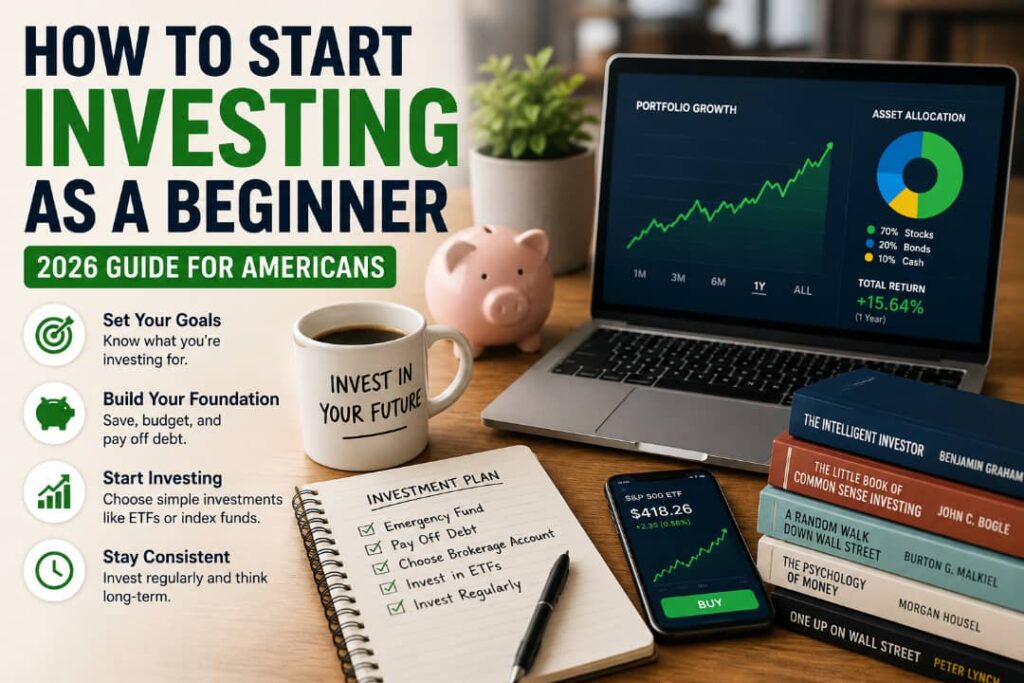
Let’s be real for a second—investing can feel overwhelming when you’re just starting out.
You hear words like stocks, ETFs, index funds, and diversification, and it quickly sounds like something only Wall Street professionals understand.
But here’s the good news: you don’t need to be an expert to start investing.
You don’t need thousands of dollars.
And you definitely don’t need to “time the market” perfectly.
What you do need is a simple approach—and that’s exactly what this guide will give you.
Why Investing Matters More Than Ever in 2026
If your money is just sitting in a savings account, it’s quietly losing value over time because of inflation.
That’s the part most people don’t realize.
Investing is how you fight back. It’s how your money starts working for you instead of just sitting there.
Over time, investments like stock market funds have historically grown much faster than cash savings. That’s why more Americans are turning to investing—not just for retirement, but to create freedom, flexibility, and peace of mind.
Step 1: Know What You’re Investing For
Before you invest anything, take a moment and ask yourself:
What’s the goal here?
- Are you trying to retire early?
- Save for a house?
- Build an extra stream of income?
Your goal shapes everything—how much risk you take, what you invest in, and how long you stay invested.
For example:
- If you need the money in a year or two, you’ll want safer options
- If you’re investing for 10+ years, you can afford to take more risks for higher returns
👉 A simple rule: the longer your timeline, the more patient (and bold) you can be.
Step 2: Get Your Financial Basics in Place
Before you jump into investing, make sure your foundation is solid.
That means:
- Having an emergency fund (3–6 months of expenses)
- Paying off high-interest debt (especially credit cards)
- Knowing where your money goes each month
This isn’t the exciting part—but it’s the part that protects you.
If you want a simple, no-fluff system for managing money, “I Will Teach You to Be Rich” by Ramit Sethi is a great place to start. It breaks things down in a way that actually makes sense in real life.
Step 3: Keep Investing Simple (Seriously)
A lot of beginners think they need to learn everything before they start.
You don’t.
Here’s all you really need to know:
- Stocks = owning part of a company
- Bonds = lending money for steady returns
- ETFs = a mix of many investments bundled together
That last one—ETFs—is where most beginners should focus.
For example, an S&P 500 ETF lets you invest in hundreds of top U.S. companies at once. Instead of betting on one company, you’re spreading your risk.
Simple. Smart. Effective.
Step 4: Open Your First Investment Account
To actually invest, you’ll need a brokerage account.
The good news? This is easier than ever in 2026.
Platforms like:
- Fidelity
- Charles Schwab
- Vanguard
- Robinhood
…make it possible to start in minutes, even with a small amount of money.
Most of them offer:
- No account minimums
- Commission-free trades
- Easy-to-use apps
You don’t need to overthink this step—just pick a reputable platform and get started.
Step 5: Start With What Works (Not What’s Trending)
This is where many beginners go wrong.
They chase:
- “Hot stocks”
- Viral crypto trends
- Social media hype
Instead, focus on what has consistently worked over time:
👉 Index funds and ETFs
These track the overall market and grow steadily over time.
You won’t get rich overnight—but you’ll build real, lasting wealth.
Step 6: Invest Consistently (Even If It’s Small)
You don’t need a lot of money to start.
What matters more is consistency.
Instead of waiting until you have $1,000 or more, start with what you can:
- $10
- $50
- $100
Then invest regularly—every week or month.
This approach is called dollar-cost averaging, and it helps you:
- Reduce risk
- Build discipline
- Grow your money steadily
Step 7: Play the Long Game
Let’s clear something up:
Investing is not a “get rich quick” strategy.
It’s a “get wealthy slowly” strategy.
And that’s actually a good thing.
The most successful investors:
- Stay invested for years (not weeks)
- Ignore daily market noise
- Focus on consistency over perfection
If you want to understand this mindset deeply, “The Intelligent Investor” by Benjamin Graham is a must-read. It’s a classic—and for good reason.
Step 8: Learn From People Who’ve Already Done It
You don’t have to figure everything out on your own.
Some of the best investing lessons are already written in books.
Here are a few beginner-friendly favorites:
- “The Intelligent Investor” – Benjamin Graham
- “The Little Book of Common Sense Investing” – John C. Bogle
- “One Up On Wall Street” – Peter Lynch
- “A Random Walk Down Wall Street” – Burton Malkiel
- “The Psychology of Money” – Morgan Housel
Each of these gives you a slightly different perspective—but together, they build a strong foundation.
Step 9: Avoid These Common Mistakes
You don’t need to be perfect—but avoiding these will save you money and stress:
❌ Trying to time the market
❌ Investing in things you don’t understand
❌ Following hype or trends
❌ Putting all your money in one place
A simple rule: if it sounds too good to be true, it probably is.
Step 10: Keep Your Portfolio Simple
You don’t need a complicated setup.
A simple beginner portfolio could look like this:
- 70% — U.S. stock market ETF
- 20% — International ETF
- 10% — Bonds
That’s it.
This gives you:
- Growth
- Stability
- Diversification
And most importantly—it’s easy to manage.
So… How Much Do You Actually Need to Start?
Here’s the part most people love:
👉 You can start with as little as $10–$100
Thanks to:
- Fractional shares
- Automated investing
- Low-cost platforms
There’s really no excuse to wait anymore.
Final Thoughts: Just Start
If there’s one thing to take away from this guide, it’s this:
Starting matters more than being perfect.
You don’t need:
- A lot of money
- Expert knowledge
- Perfect timing
You just need to take that first step—and keep going.
Because over time, small, consistent actions turn into real wealth.
Frequently Asked Questions
1. Can I really start investing with little money?
Yes, you absolutely can. In 2026, many U.S. brokerage platforms allow you to start investing with as little as $10 thanks to fractional shares. The key isn’t how much you start with—it’s how consistently you invest over time.
2. What is the best investment for beginners?
For most beginners, low-cost index funds or ETFs are the best place to start. They spread your money across many companies, reducing risk while still offering steady growth over time.
3. Do I need a lot of knowledge before I start investing?
No. You don’t need to know everything before you begin. In fact, many successful investors started with just the basics and learned along the way.
A great beginner-friendly resource is “The Psychology of Money” by Morgan Housel, which focuses more on mindset than complex strategies.
4. Is investing risky for beginners?
All investing involves some level of risk—but not investing at all can be risky too because of inflation.
The best way to reduce risk as a beginner is to:
- Invest in diversified funds (like ETFs)
- Invest consistently over time
- Avoid chasing trends
5. How do I choose the right brokerage account in the U.S.?
Look for platforms that offer:
- No minimum deposit
- Commission-free trades
- Easy-to-use apps
- Strong customer support
Popular beginner-friendly options include Fidelity, Vanguard, Charles Schwab, and Robinhood.
.
6. Should I invest in stocks or ETFs as a beginner?
If you’re just starting out, ETFs are usually the safer and simpler choice because they give you instant diversification.
Individual stocks can be more volatile and require more research.
7. What is dollar-cost averaging and why is it important?
Dollar-cost averaging means investing a fixed amount of money regularly—regardless of market conditions.
This strategy helps:
- Reduce the impact of market volatility
- Build discipline
- Grow your portfolio steadily over time
8. How long should I keep my money invested?
Investing works best when you think long-term—typically 5 to 10 years or more.
Trying to make quick profits often leads to losses. Patience is one of the most important skills in investing.
9. What are the biggest mistakes beginners make?
Some of the most common mistakes include:
- Trying to time the market
- Following hype or trends
- Not diversifying investments
- Investing money they might need soon
10. Can I lose all my money when investing?
It’s very unlikely if you invest in diversified funds like ETFs.
Losing all your money usually happens when:
- You invest in high-risk assets
- You put all your money into one investment
Diversification is your best protection.
11. How do I start investing step by step?
Here’s a simple beginner roadmap:
- Set your financial goals
- Build an emergency fund
- Open a brokerage account
- Start with ETFs or index funds
- Invest consistently
12. Are investing books worth it for beginners?
Yes, they can save you years of trial and error.
A great starting point is “The Intelligent Investor” by Benjamin Graham, which teaches long-term investing principles.
13. Is it better to invest or save money?
Both are important.
- Saving is for short-term needs and emergencies
- Investing is for long-term growth
A smart financial plan includes both.
14. What’s the safest way to invest as a beginner?
While no investment is 100% safe, you can reduce risk by:
- Investing in index funds or ETFs
- Diversifying your portfolio
- Staying invested long-term
15. How can I stay consistent with investing?
The easiest way is to automate your investments.
Set up automatic deposits weekly or monthly so you don’t have to think about it.
16. Do I need to follow the stock market every day?
No—and in fact, it’s better if you don’t.
Constantly checking the market can lead to emotional decisions. Successful investors focus on the long term, not daily fluctuations.
17. What’s the difference between active and passive investing?
- Active investing: Trying to beat the market by picking stocks
- Passive investing: Tracking the market using index funds or ETFs
Most beginners are better off with passive investing because it’s simpler and more reliable over time.
18. Can investing help me achieve financial freedom?
Yes—but it takes time, consistency, and discipline.
Investing allows your money to grow and compound over the years, which can eventually replace your active income.
19. How do taxes work on investments in the U.S.?
Investment earnings may be subject to:
- Capital gains tax
- Dividend tax
Tax-advantaged accounts like IRAs and 401(k)s can help reduce your tax burden.
20. What’s the best mindset for a beginner investor?
Focus on:
- Long-term growth
- Consistency over perfection
- Learning as you go
A great mindset-focused read is “The Little Book of Common Sense Investing” by John C. Bogle, which emphasizes simplicity and patience.