
Let’s be real for a second—life has a way of catching you off guard. One minute everything is fine, and the next, your car breaks down, your rent goes up, or a medical bill shows up out of nowhere. It’s stressful, and for a lot of people, it feels like there’s no room to breathe financially.
That’s exactly where an emergency fund comes in. It’s not some complicated financial strategy—it’s simply your backup plan. Your safety net. The thing that keeps a bad situation from turning into a financial disaster.
And here’s the part most people get wrong: you don’t need to be rich to build one. You just need a simple plan—and the discipline to stick with it.
Let’s walk through this together.
What Is an Emergency Fund (And Why You Actually Need One)
An emergency fund is money you set aside specifically for the unexpected. Not for shopping, not for vacations, and definitely not for things you can plan for.
We’re talking about real-life situations like:
- A sudden medical bill
- Car repairs you didn’t see coming
- Losing your job
- Urgent home fixes
Think of it like a financial cushion. Without it, even a small emergency can push you straight into debt.
That’s why books like The Total Money Makeover emphasize building a cash buffer first before anything else. Because honestly, investing doesn’t matter much if one emergency wipes you out.
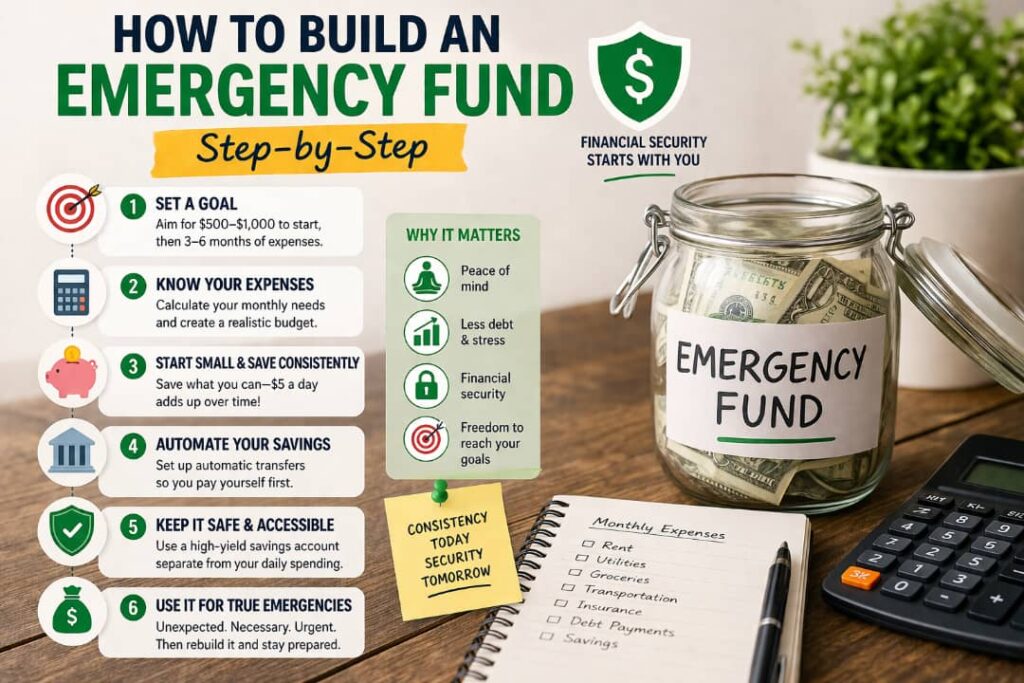
Step 1: Set a Goal That Makes Sense for You
Before you start saving, you need a target. Otherwise, you’re just guessing—and guessing rarely works with money.
Start Small (Yes, Really)
Your first goal should be simple:
- $500 to $1,000
This might not cover everything, but it handles the most common emergencies. And more importantly, it builds momentum.
Then Build Up to the Real Goal
Eventually, you want:
- 3 to 6 months of living expenses
So if your monthly expenses are around $2,200, you’re looking at:
- $6,600 to $13,200
That might sound like a lot—and it is. But you’re not saving it overnight.
This idea is strongly reinforced in Your Money or Your Life, which encourages aligning your savings with your actual lifestyle—not some unrealistic number.
Step 2: Know Your Numbers (Without Overcomplicating It)
You don’t need spreadsheets or fancy apps to figure this out.
Just ask yourself:
“If my income stopped today, what would I absolutely need to survive each month?”
Focus on:
- Rent or mortgage
- Food
- Utilities
- Transportation
- Minimum debt payments
That’s your baseline. Your survival number.
And once you know that, your emergency fund goal becomes much clearer—and way more realistic.
Step 3: Start Small and Stay Consistent
Here’s where most people mess up—they try to do too much, too fast.
Saving $1,000 sounds great… until life happens and you quit after two weeks.
Instead, start with something you know you can stick to:
- $5 a day
- $25 a week
- $100 a month
It may feel slow, but it works.
In I Will Teach You to Be Rich, the focus is on building simple, consistent systems—not relying on motivation. Because motivation fades, but habits stick.
Step 4: Make Saving Automatic (So You Don’t Have to Think About It)
If you have to remind yourself to save every month, chances are… you won’t.
The easiest fix? Automate it.
Set up:
- Automatic transfers from checking to savings
- Direct deposit splits from your paycheck
Even $50 per paycheck adds up faster than you think.
Treat it like a bill. Something non-negotiable.
Because when saving becomes automatic, it stops feeling like a chore.
Step 5: Keep Your Emergency Fund in the Right Place
Where you keep your money matters more than people think.
Your emergency fund should be:
- Safe
- Easy to access
- Separate from your daily spending
A high-yield savings account is usually your best bet.
What you don’t want:
- Stocks (too unpredictable short-term)
- Crypto (way too volatile)
- Anything that locks your money away
This isn’t about growing your money—it’s about protecting it and being able to use it when you need it.
Step 6: Cut Back—But Don’t Make Yourself Miserable
Let’s be honest: extreme budgeting doesn’t last.
You don’t need to cut out everything you enjoy. Just look for small, easy changes:
- Cancel subscriptions you don’t use
- Eat at home a bit more often
- Think twice before impulse buying
For example: Skipping a $6 coffee three times a week saves you about $72 a month.
That’s nearly $900 a year—just from one small habit.
The goal isn’t to suffer. It’s to be intentional.
Step 7: Increase Your Income (If You Can)
Sometimes, cutting expenses isn’t enough—especially if you’re already on a tight budget.
That’s where extra income can make a huge difference.
You don’t need anything complicated. Even small side hustles can help:
- Freelancing online
- Selling things you don’t use
- Delivery or gig work
An extra $200 a month might not sound life-changing—but it can get your emergency fund fully started much faster.
Step 8: Use Your Fund the Right Way
This is where discipline really matters.
Before you touch your emergency fund, ask yourself:
- Is this unexpected?
- Is it necessary?
- Is it urgent?
If the answer is no, don’t use it.
A sale? Not an emergency.
A broken car you need for work? That’s exactly what it’s for.
And if you do use it, make rebuilding it your next priority.
Step 9: Build It in Phases (So It Doesn’t Feel Overwhelming)
Trying to save thousands of dollars all at once can feel impossible.
So don’t.
Break it down:
Phase 1: $500–$1,000
→ Covers small emergencies
Phase 2: 1 month of expenses
→ Gives you breathing room
Phase 3: 3–6 months of expenses
→ Full financial security
Each phase builds confidence—and makes the next step easier.
Step 10: Stay Consistent (Even When It Feels Slow)
This part isn’t exciting—but it’s the most important.
There will be times when progress feels slow. When saving feels hard. When you’re tempted to stop.
Don’t.
Because every dollar you save is one less dollar you’ll need to borrow later.
As emphasized in The Total Money Makeover, small, consistent actions over time are what actually change your financial life.
Mistakes You’ll Want to Avoid
A few things that can trip you up:
- Waiting until you “make more money” to start
- Keeping your savings where it’s easy to spend
- Using the fund for non-emergencies
- Forgetting to rebuild it after using it
Avoid these, and you’re already ahead of most people.
What Changes Once You Have an Emergency Fund
This is where things get interesting.
With an emergency fund:
- You stop depending on credit cards
- You stress less about unexpected expenses
- You feel more in control of your money
- You can actually start thinking about building wealth
It’s not just about dollars—it’s about peace of mind.
Final Thoughts: Just Start
You don’t need the perfect plan.
You don’t need a high income.
You don’t need to wait.
You just need to start.
Even if it’s $10. Even if it’s slow.
Because progress—no matter how small—is still progress.
Stick with it. Be consistent. Protect what you build.
And over time, you’ll look back and realize you’ve created something powerful: financial stability.
One step at a time.
Frequently Asked Questions
1. What is an emergency fund and why is it important?
An emergency fund is money set aside for unexpected expenses like medical bills, car repairs, or job loss. It protects you from going into debt and gives you peace of mind.
To get started easily, consider using tools like Chime or Ally Bank, which let you create separate savings accounts specifically for emergencies.
2. How much should I have in my emergency fund in 2026?
Most experts recommend saving 3 to 6 months of living expenses, but beginners should aim for $500 to $1,000 first.
If you’re unsure how to calculate your expenses, budgeting apps like YNAB or Mint can help you break down your monthly costs quickly.
3. How long does it take to build an emergency fund?
It depends on your income and consistency. For most people, it takes 3 months to 2 years to fully fund.
To speed things up, automation tools like Digit can analyze your spending and automatically save small amounts for you.
4. Where should I keep my emergency fund?
The best place is a high-yield savings account—safe, accessible, and earning some interest.
Popular options include Ally Bank and Discover Bank, which offer competitive interest rates and easy access to your money.
5. Should I invest my emergency fund?
No—your emergency fund should stay in a safe, liquid account. Investing it in stocks or crypto can expose you to losses when you need the money most.
Instead, keep it in a reliable savings platform like SoFi that combines accessibility with decent interest earnings.
6. What qualifies as an emergency expense?
An emergency is something unexpected, necessary, and urgent—like a hospital bill or essential car repair.
To avoid accidentally spending your emergency fund, apps like PocketGuard help you track where your money goes and prevent overspending.
7. Can I build an emergency fund with a low income?
Yes, absolutely. Even saving small amounts consistently can build a solid fund over time.
Apps like Acorns round up your purchases and save spare change automatically, making it easier to start with very little.
8. Should I pay off debt or build an emergency fund first?
Start with a small emergency fund ($500–$1,000), then focus on paying off high-interest debt.
Debt payoff tools like Undebt.it or Tally can help you create a structured repayment plan.
9. How can I save money fast for an emergency fund?
You can save faster by cutting expenses, increasing income, and automating savings.
To find extra money in your budget, apps like Rocket Money can identify and cancel unused subscriptions instantly.
10. How often should I contribute to my emergency fund?
You should contribute regularly—weekly, biweekly, or monthly.
Automating this process through platforms like Chime ensures you stay consistent without relying on memory or motivation.
11. What’s the difference between an emergency fund and a savings account?
An emergency fund is the purpose, while a savings account is the tool used to store that money.
Using a dedicated account like Capital One 360 helps you separate emergency savings from everyday spending.
12. Can I use my emergency fund for planned expenses?
No. Planned expenses should have their own savings category.
You can organize multiple savings goals using apps like Qapital, which lets you create separate buckets for different purposes.
13. What happens if I use my emergency fund?
If you use it, your priority should be rebuilding it as soon as possible.
To stay on track, automated savings apps like Digit can help you rebuild your fund without overthinking it.
14. How do I stay motivated to save an emergency fund?
Set small goals, track progress, and celebrate milestones.
Apps like YNAB visually show your progress, which can keep you motivated as your savings grow.
15. Is $1,000 enough for an emergency fund?
$1,000 is a great starting point, but it’s not enough long-term. You should aim for 3–6 months of expenses eventually.
To grow beyond your starter fund, high-yield platforms like SoFi can help your savings earn more over time.
16. What are the best apps to help build an emergency fund?
Some of the best apps include:
- YNAB (budgeting)
- Chime (banking + savings)
- Acorns (automated saving)
These tools simplify saving and help you stay consistent.
17. How do I build an emergency fund quickly in 2026?
Increase your income, cut expenses, and automate savings.
Platforms like Fiverr or Upwork can help you earn extra income to boost your savings faster.
18. Do I need an emergency fund if I have insurance?
Yes. Insurance often comes with deductibles and delays, so you still need cash on hand.
Keeping your emergency fund in a reliable account like Ally Bank ensures you can access it immediately when needed.